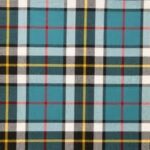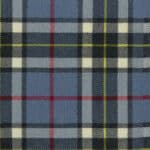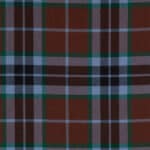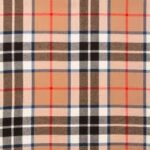
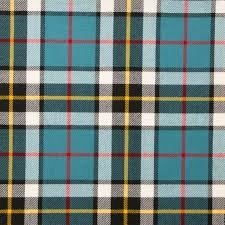
 Thomson Dress Blue Modern
Clan Thomson
Thomson is a patronymic — son of Thom, or Thomas — and it was formed independently in many places at once, so there is no single Thomson family and never was. Three strands matter when choosing cloth. The first is Argyll and Perthshire, where a great many Thomsons are MacTavishes: Gaelic Mac Tàmhais, son of Tàmhas, with the chiefly seat at Dunardry in Knapdale. A document of 1633 has a John Thomson witnessing alongside Archibald McCawis of Dunardry. The second strand is Clan MacThomas of Glenshee in Perthshire, descended from Tomaidh Mòr, a grandson of William Mackintosh, seventh chief of Mackintosh, who took his people out of Badenoch across the Grampians in the fifteenth century; some of his descendants moving south into the Tay valley became Thomsons. The third is Lowland and Border: Thomsons of Eskdale, the Lothians and Duddingston near Edinburgh, with no Highland connection whatever. Thomson is the usual Scottish spelling, Thompson the northern English one; they are the same name.
Because the name is shared rather than descended, the dated history belongs to the clans behind it. Duncan MacTavish, sixth of Dunardry, died at Flodden in 1513 alongside the second Earl of Argyll; the first surviving feudal charter for Dunardry is of 1533. Dugald MacTavish, fourteenth chief, was hanged at twenty-one after the surrender of Carnasserie Castle in Argyll’s rising of 1685, and in 1745 chief Archibald MacTavish was imprisoned in Dumbarton Castle. Dunardry was sold at public auction in 1785, and the chiefship then lay dormant some two hundred years until Edward Stewart Dugald MacTavish was recognised twenty-sixth chief in 1997. Clan MacThomas appears in the parliamentary rolls of 1587 and 1594 and moved its seat to Finegand about 1600. The late Lord Lyon David Sellar put the position squarely: the MacTavishes and MacThomases are Highland clans, but the Thomsons as such cannot be described as one.
The Thomson tartan
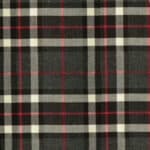
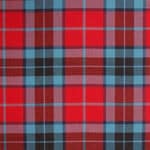
The Register makes the relationship plain, because it declines to separate the names. The principal clan setts are all recorded jointly: MacTavish/Thompson/Thomson – 1880, MacTavish/Thompson/Thomson – 1906, MacTavish/Thompson/Thomson Dress Blue, MacTavish/Thompson/Thomson Hunting, MacTavish, Thompson, Thomson Camel by J. C. “Scotty” Thompson, and Thompson/Thomson/MacTavish special grey by D. C. Dalgliesh of Selkirk. What is recorded under Thomson alone is largely trade cloth: Thomson Dress (Blue) and Thomson (Personal) credited to Bain and Bottomley, a Thomson Dress (Grey) and a Thomson Camel from Jedburgh Woollen Mill, both categorised as Fashion, and, on the Thompson spelling, a Grey Dress and a Black from Pringles of Inverness. The Oor Wullie and Broons tartans of 2011 belong to the publisher D. C. Thomson, not to the surname as a clan name. No Thomson or MacTavish record carries a Wilsons of Bannockburn attribution.
In practice, the red setts are MacTavish’s, and the Clan Thom(p)son Society deliberately avoids red to stay clear of them, taking the Dress Blue as its own. The hunting sett was designed for Lord Thomson of Fleet in 1958 from a mid-nineteenth-century sample in the Moy Hall collection. If your line is Glenshee rather than Knapdale, the MacThomas setts are the right ones to look at instead.
A note on honesty: there is no Clan Thomson and no Thomson chief. The Lord Lyon recognises no chief of the name Thomson or Thompson, and the name does not appear on the roll of the Standing Council of Scottish Chiefs. Every tartan sold as Thomson is therefore one of three things: a MacTavish sett shared under a joint name, a twentieth-century commission such as the 1958 hunting, or a mill’s fashion cloth — the camel and grey lines were woven for car rugs and coats. Ancient, Modern and Weathered are dye recipes applied to the same threadcount, not separate tartans.
Clan facts
| Chief | None. No chief of the name Thomson or Thompson is recognised by the Lord Lyon or listed by the Standing Council of Scottish Chiefs. Thomsons of MacTavish descent look to the MacTavish of Dunardry; those of Glenshee descent to Andrew MacThomas of Finegand, 19th Chief |
|---|---|
| Motto | None recorded for the name itself. MacTavish: Non Oblitus — “Not forgetful”. MacThomas: Deo Juvante Invidiam Superabo — “With God’s help I shall overcome envy” |
| Plant badge | None recorded for Thomson, there being no chief |
| Lands | Dunardry in Knapdale, Argyll (MacTavish); Glenshee in Perthshire, with the seat at Finegand from about 1600 (MacThomas); Eskdale, the Lothians and Duddingston for the Lowland Thomsons |