 Irvine Ancient
Clan Irvine and Clan Irving
There are two recognised chiefships here, not one, and they are parallel rather than rival. The Aberdeenshire line begins with a grant by Robert I in 1323 of the royal forest and tower of Drum to William de Irwyn, described as the king’s armour-bearer, roughly ten years after Bannockburn. The National Trust for Scotland, which owns Drum Castle, gives the year as 1323 and the grantor as Robert the Bruce. A Clan Irving publication attributes the grant to David II, which cannot be right, since David II did not reign until 1329. We have not seen the charter, so this page gives the year and nothing more precise. The Irvines held Drum for some six hundred and fifty years; the 24th Laird agreed transfer to the Trust in 1964 and Irvine ownership ended in 1975.
The Dumfriesshire Irvings were a Border reiving family seated at Bonshaw Tower, distinct in territory and history from the Irvines of Drum, and their chiefly line traces to William Irving of Bonshaw in the 1670s. Bonshaw was sold in 1955 and Drum in 1975, but both chiefships survive. Alexander Irvine of Drum succeeded as 27th Baron of Drum and Chief of the Name and Arms of Irvine of Drum in 2019, and Rupert Irving of Bonshaw had his succession as Chief of the Name and Arms of Irving of Bonshaw confirmed by the Lord Lyon in March 2021. Both sit on the Standing Council of Scottish Chiefs, and neither claims seniority over the other. The tradition connecting Drum’s origin to an eleventh-century Duncan Irvine at Bonshaw is tradition, with no charter behind it.
The Irvine tartan
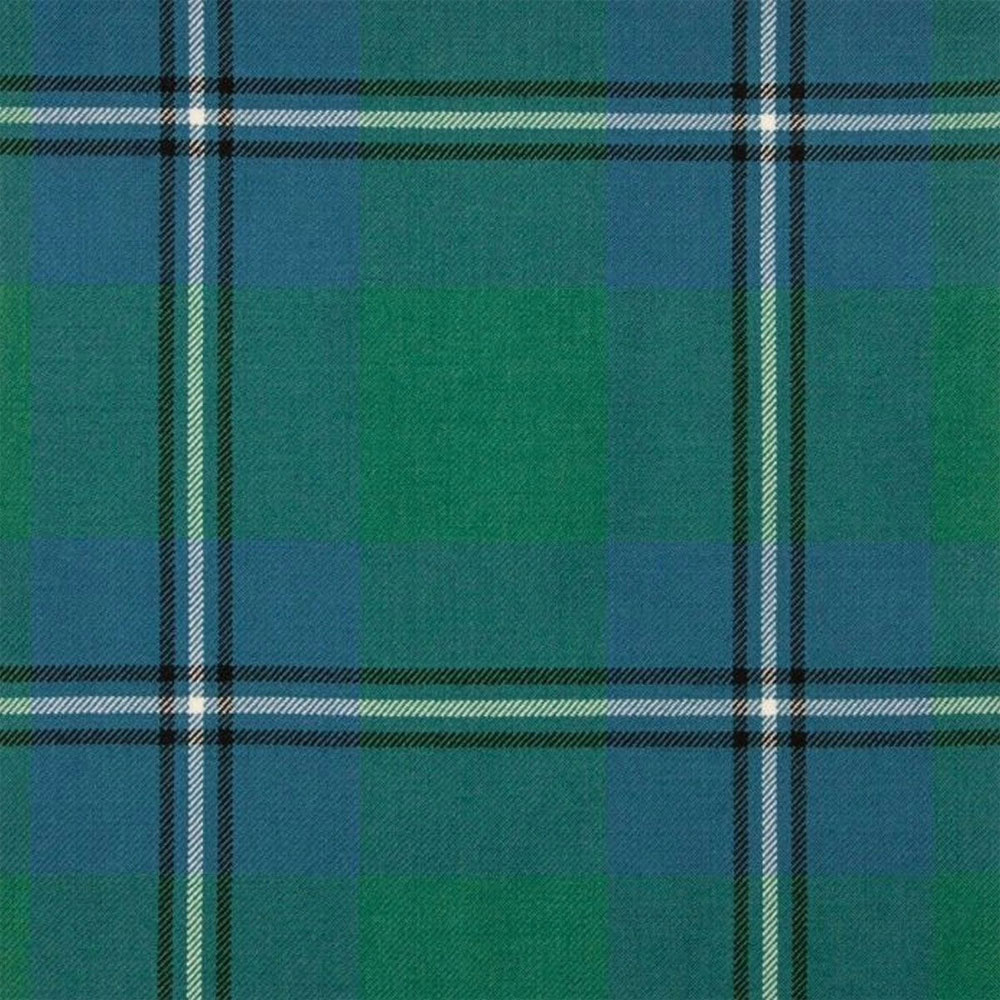
Across all three spellings the register holds exactly two clan or family setts: Irvine of Drum and Irving of Bonshaw. Everything else the searches return is a personal, corporate or commemorative registration. Under Irvine there are two personal tartans designed by Glenn Irvine and one, The Irvine Valley, named for a place in Ayrshire. Under Irving there are two personal tartans, Irving of Bonshaw Tower by Bruce Irving and Irving of Glentulchan by Peter MacDonald. Irving of Bonshaw Tower is especially easy to confuse with the clan sett, and is a different registration. A search for Irwin returns no clan tartan at all: the Clan Irwin Association tartan of 2020 is correctly filed as corporate, and Irwin or Erwin bearers wear Irvine of Drum or Irving of Bonshaw.
Of the two clan setts, Irving of Bonshaw carries the designer field “Scottish Tartans Society” — a body founded in 1963 — so it is either a Society design or a Society record, and either way twentieth century. Irvine of Drum carries no designer and no date at all. Neither name appears in the Vestiarium Scoticum, which is a point in their favour, and we found no Wilsons of Bannockburn attribution for either.
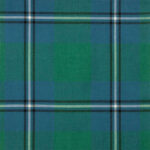
A note on honesty: we cannot document a date for the Irvine of Drum sett and will not invent one, because the register records neither a designer nor a date for it. No Irvine or Irving sett predates the commercial era, and the charter of 1323 dates the lands of Drum, not any cloth. “Irvine Ancient”, “Irvine Modern” and “Irving Weathered” are not separate registered tartans but dye colourways of one of the two threadcounts above.
Clan facts
| Chiefs | Alexander Irvine of Drum, 27th Baron of Drum, Chief of the Name and Arms of Irvine of Drum, since 2019; and Rupert Irving of Bonshaw, 20th of Bonshaw, Chief of the Name and Arms of Irving of Bonshaw, confirmed in March 2021 |
|---|---|
| Motto | Sub sole sub umbra virens — “Flourishing both in sunshine and in shade”, for Irvine of Drum. No motto is recorded to us for Irving of Bonshaw, and we do not borrow the Drum motto for it |
| Plant badge | Holly, for Irvine. The sheaf of holly of nine leaves often quoted is the heraldic crest rather than the plant badge. Not recorded for Irving of Bonshaw |
| Lands | Drum Castle, Aberdeenshire, held about six hundred and fifty years to 1975 and now owned by the National Trust for Scotland; Bonshaw Tower, Dumfriesshire, sold in 1955. No Gaelic patronymic is recorded for either name |