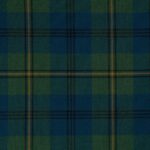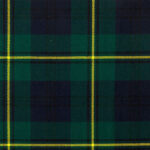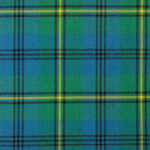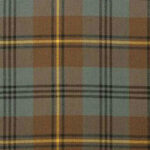
 Johnstone Muted
Clan Johnstone
Johnstone is a territorial name, from a place in Annandale meaning John’s farmstead, and not a patronymic. The earliest individual usually cited is Gilbert de Jonistune, appearing in Annandale charters in the reign of William the Lion; the references give a range rather than a single year and rest on secondary reference works, so this page says the name is recorded in Annandale charters by the end of the twelfth century and leaves it there. The family held Annandale under the Bruce lordship, and by the fourteenth century their principal stronghold was Lochwood Tower, some six miles south of Moffat. Lochwood was burnt by the Maxwells and Armstrongs in 1585, rebuilt, visited by James VI in October 1592, and abandoned around 1724.
The Johnstones were a leading riding family of the West March and repeatedly held the office of Warden, which is what set them structurally against the Maxwells, who held the same office. The feud came to a head at Dryfe Sands, near Lockerbie, on 6 December 1593, where Sir James Johnstone with perhaps six to eight hundred men defeated John Maxwell, eighth Lord Maxwell, with about two thousand; Lord Maxwell was killed in the battle. The casualty figures that circulate come from nineteenth-century and Johnstone-friendly accounts and should be read as estimates. The sequel is the other half of the story: in 1608, at a meeting arranged to reconcile the families, the dead Maxwell’s son shot and killed Sir James Johnstone, and was himself executed in 1613. The claim that the Johnstones raided only into England and never among their neighbours is partisan clan tradition, and the Maxwell feud is its own refutation.
The Johnstone tartan
The register’s Johnstone entries need sorting carefully, because most of what a search turns up is not clan wear. Johnstons of Elgin Bicentennial is the Elgin woollen mill, a company. St Johnstone Football Club is the Perth football club, named for the old name of Perth. Aberdeen (Johnston and Smith) is a district tartan of Aberdeen, the names being those of the compilers. Johnston Orange/Black is a corporate tartan by an American textile company, MacTaggart (Johnstons) is a MacTaggart sett whose source was the Johnstons firm, and several further entries are personal tartans.
The clan setts are three. The principal Johnston/Johnstone entry carries the designer field “Sobieski Stewarts, The”, which is the register stating that the pattern comes from the Vestiarium Scoticum of 1842, where it is plate 74, “Johnstoun”. That book is a forgery: Sir Walter Scott doubted it in 1829, and in 1895 chemical testing showed the manuscript had been treated to age the writing. Clan Johnston/e in America says as much on its own tartan page, and adds the wider point that most clan tartans accepted today are no older than the first quarter of the nineteenth century. A second entry, Johnstone/Johnston, has its own separate number in the older collections and so is probably a different threadcount, but the register gives it no designer and no date and we can establish nothing about its origin. Johnston Dress (Dalgleish) is credited to the Selkirk weavers D. C. Dalgliesh.
A note on honesty: the earliest a Johnstone sett can be documented is 1842, and its source is a forged manuscript; no Johnstone sett predates the commercial era. There are no Modern, Ancient, Weathered or Muted Johnstone registrations — those are dye palettes applied to the same pattern, as the clan society itself explains. Nor do Johnston and Johnstone have separate tartans: the register cross-names both records, so a Johnston and a Johnstone may wear either, and anyone selling the two spellings as different tartans is inventing a distinction. The red hawthorn plant badge is given by the clan society, which describes it frankly as probably a nineteenth-century invention.
Clan facts
| Chief | The Earl of Annandale and Hartfell — Patrick Hope-Johnstone, Chief of the Name and Arms of Johnstone. His father was recognised as chief by the Lord Lyon in 1982 and he succeeded to the chiefship in 1983. The earldom itself, dormant from 1792, was a separate matter: the House of Lords Committee for Privileges allowed the claim in 1985, holding that the charter of regrant of 1662 had created a new earldom whose succession admitted the female line, and he was summoned to the Lords in 1986. The marquessate of Annandale of 1701 remains dormant |
|---|---|
| Motto | Nunquam non paratus — “Never unprepared”. The Caskieben branch uses Vive ut vivas — “Live that you may live” — with a different crest, and the two should not be conflated |
| Plant badge | Red hawthorn, described by the clan society itself as probably a nineteenth-century attribution |
| Lands | Annandale, Dumfriesshire, and the Scottish West March; Lochwood Tower, near Moffat. No Gaelic patronymic is recorded — Johnstone is a Lowland and Border territorial name |