 Mowat Modern
Clan Mowat
Mowat is a Norman territorial name, not a Gaelic one. It comes from the Norman French Mont Hault, high mount, latinised as de Monte Alto and worn down through Montealto to Mowat — an etymology the family motto preserves. A Robert de Montealto is said to have been on record in the reign of David I, between 1124 and 1153, though we have not been able to trace that name to a primary source and give no exact year for it. The family held the lordship of Fern in Angus during the reign of William the Lion, between 1165 and 1214, and the name survives there in Mowat’s Seat on Bruff Shank Hill. Their chiefly seat was Balquholly in Aberdeenshire, later rebuilt by the Duffs and renamed Hatton Castle.
A branch of the Fern line, the Mowats of Bucholie, acquired Freswick and Harpsdale in Caithness, restored the Norse castle of Lambaborg and renamed it Bucholie. Sources conflict on how that came about: one account gives a charter of Freswick in the reign of Robert the Bruce, between 1306 and 1329, while cautioning that such charters often confirmed possessions already inherited; another dates the acquisition to 1410. Freswick was lost to the Sinclairs in the middle of the sixteenth century and returned in 1635. The best-attested date in the family’s history is 1661, when Magnus Mowat of Bucholie sold the Caithness estates; Balquholly followed in 1727, when John Mowat, third laird, disposed of it. Branches settled in Orkney and Shetland, where the name is pronounced “Mode”. The claim that Mowat is a sept of Clan Sutherland rests on a single American compilation of 1862 and is contradicted by other authorities; we do not repeat it.
The Mowat tartan
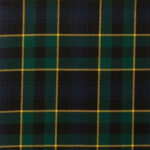
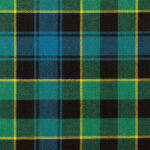
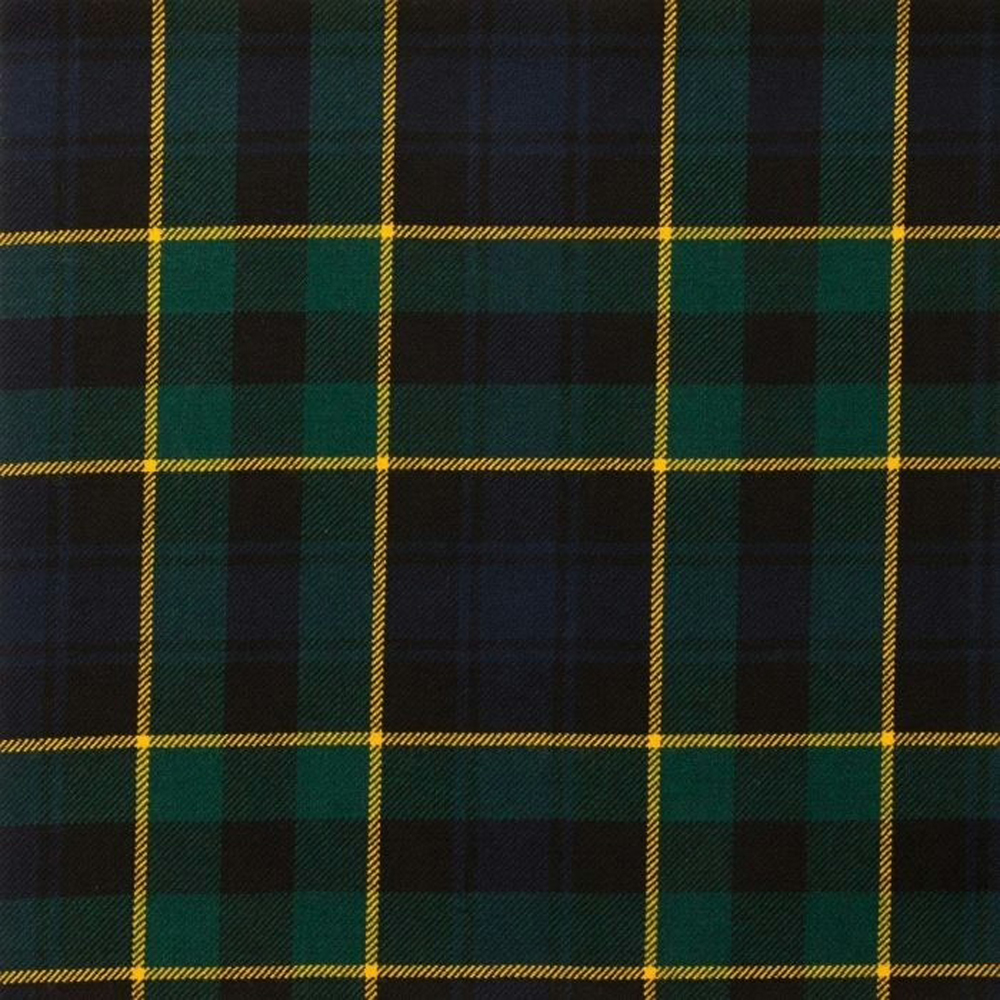
There is one Mowat clan sett. The Scottish Register of Tartans records it with the title Mowat (Clans Originaux), and a date of 1880; it is a seven-band pattern of 268 threads. We have not been able to establish what Clans Originaux is, and no designer is named, so the attribution is reported here exactly as the register gives it and no more. A second entry, Mowat, Sir Oliver, is a genuinely distinct sett of nineteen bands rather than seven; it is a historical or personal tartan and the sources do not record its designer, its date, or whom it commemorates.
A note on honesty: Mowat Modern and Mowat Ancient are the two colourways in which the single sett is woven, not two tartans — they differ in colour and cloth weight only. A 267-thread recording of the same pattern exists alongside the 268-thread one; that is a one-thread discrepancy between cloths, not a second design. No Mowat sett predates the commercial era: nothing is recorded before 1880, the name appears nowhere in the Vestiarium Scoticum of the Sobieski Stuarts, and there is no Wilsons of Bannockburn attribution.
Clan facts
| Chief | None. Mowat is an armigerous clan with no chief recognised by the Lord Lyon, and no commander has been appointed |
|---|---|
| Motto | Monte Alto — “on a high mountain” |
| Plant badge | Not recorded |
| Lands | The lordship of Fern, Angus; Balquholly, later Hatton Castle, Aberdeenshire; Freswick and Bucholie Castle, Caithness; branches in Orkney and Shetland |