
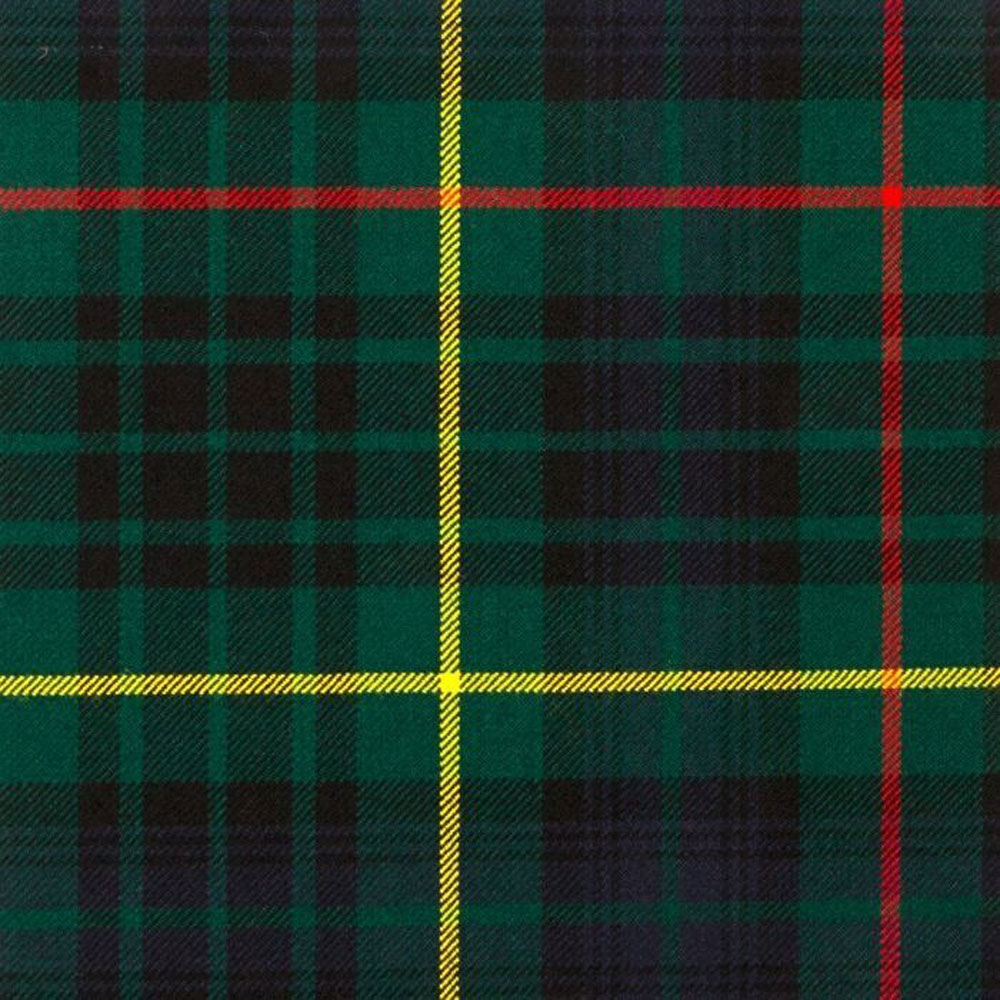
 Hunting Stewart
A green sett that carries a Stewart name, repeats instead of reflecting, and owes more to a Stirlingshire weaving shed than to any Stewart chief.
Before 1819, at Bannockburn
The earliest solid record is commercial. Wilsons of Bannockburn had the pattern in their books before 1819, in a form not quite the one now woven, and the early version carried irregularities that have since been tidied away. As Wilsons set it out, a group of four bars ran with the inner pair at roughly double the width of the outer pair, that group repeating across both a black and a blue ground, bounded in black and crossed by overchecks of red and yellow, with the spacing differing between the dark sections. A weaver’s note of that kind is worth more than a tradition: it fixes a date, it fixes a place, and it shows the sett already in trade before the tartan boom of the 1820s.
What the Allen brothers did to it
Around 1825 the brothers who called themselves John Sobieski Stuart and Charles Edward Stuart were experimenting with a green tartan they named Stewart hunting. Their revision enlarged the blue area by repeating narrower blue bars each with its own adjoining black line, and the result reads much closer to the Black Watch than the Wilsons original did. That revision is essentially the Hunting Stewart sold today, which puts the modern sett in an awkward position: its shape was settled by the same pair whose Vestiarium Scoticum of 1842 is now accepted as a fabrication, its claimed sixteenth-century manuscript never produced and its 1721 copy shown in 1895 to have been chemically aged. The pre-1819 Wilsons entry is independent of them and is what gives the design a genuine documentary footing; the Stewart name on it does not have an equivalent footing at all.
The sett that does not reflect
Most tartans are symmetrical: the sequence of stripes runs out from a pivot and mirrors back, so the cloth reads the same in either direction. Hunting Stewart does not. It is asymmetric — the sequence simply repeats — and that is the quickest way to identify it. The practical consequences are real. An asymmetric sett has a direction, so it has to be cut and pleated with that direction kept consistent, matching at the joins is a different problem from matching a mirrored sett, and a piece laid the wrong way round shows. A small number of well-known tartans behave this way, and this is the most widely worn of them.
A tartan nobody has to ask for
Before the trade made the Royal Stewart general, Hunting Stewart and the Black Watch were the two setts that a Scot with no clan claim could wear without argument, and Hunting Stewart has kept that standing. No chief restricts it. No clan owns it. It is the usual choice for pipe bands, schools, societies and anyone who wants a Highland outfit without asserting a descent, and it needs no permission because there is nobody to grant any. The Royal Stewart now fills much the same role, but that is a commercial development of the last century or so rather than an old rule, and the Stewart Society puts its position on the royal sett in terms of subjects of the sovereign rather than of the clan.
One caution about the name. A distinct Hunting Stewart of Appin exists, built on the overchecking used in the MacDonald tartans, and the Scottish Tartans Society files preserve a long exchange over whether that Appin sett should be called hunting or ancient. James Scarlett recorded a related early nineteenth-century count as number 417 in Tartan: The Highland Textile in 1990, and judged that its brown had probably started life as black. Hunting in a Stewart tartan name is therefore not a reliable guide to anything: it may mean this general green sett, it may mean an Appin branch pattern, and in the mills it is sometimes doing no more than marking a darker colourway of a red sett.
Sources: The Stewart Society, Hunting Stewart and Stewart of Appin tartan pages; Peter Eslea MacDonald, Old & Rare Scottish Tartans by D. W. Stewart: an examination (2022), scottishtartans.co.uk; Wikipedia, Vestiarium Scoticum; Wikipedia, Royal Stewart tartan; James Scarlett, Tartan: The Highland Textile (1990), as cited by the Stewart Society.