
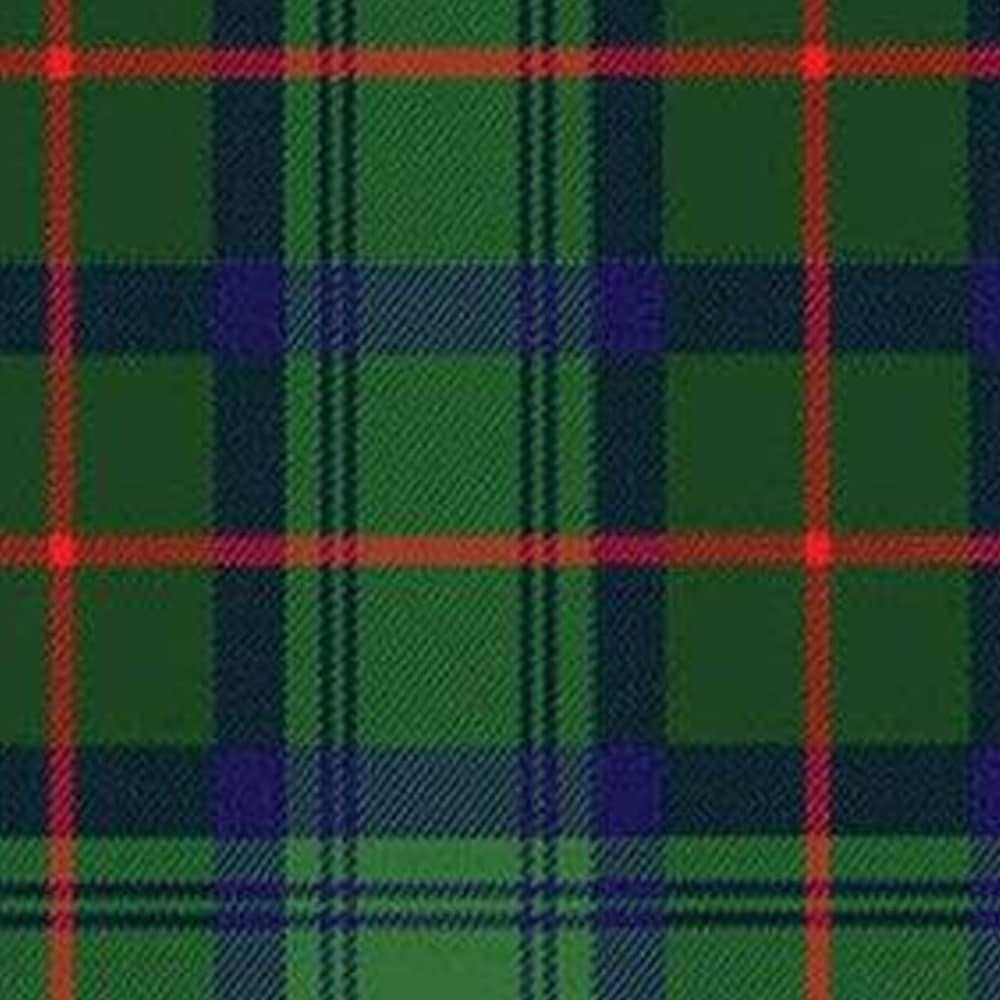
Clan Cranstoun
Cranstoun is a territorial name, from the lands and barony of Cranstoun in Midlothian. This is a family of the Scottish Lowlands and not a Highland clan, which is worth saying because so much tartan copy implies otherwise. The suggested etymologies — Anglo-Saxon for the place of the crane, which the crane on the shield and crest would suit, or the dwelling-place of a man called Cran — are presented in the sources as suggestions, not as established. The earliest sourced bearer is Elfrick de Cranstoun, who witnessed a charter from William the Lion to Holyrood Abbey and who appears about 1170 in a deed between Roger de Quincy and the Abbot of Newbattle. Thomas de Craystoun recorded a donation of lands near Paiston in East Lothian in the reign of Alexander II; Hugh de Cranstoun swore fealty to Edward I on the Ragman Rolls in 1296; Randolphus de Cranstoun gave to Newbattle Abbey in 1338; and David II granted Thomas de Cranston a charter for all the lands of Cranston.
In 1592 Thomas and John Cranstoun, kinsmen of the chiefly family, were accused of treason for assisting Francis Stewart, 5th Earl of Bothwell, in his attack on Holyrood Palace. In June 1600 Sir John Cranstoun of that Ilk was indicted for harbouring those traitors and obtained a stay of proceedings only on the King’s intervention, and that August his brother Thomas was executed at Perth for his part in the Gowrie Conspiracy to seize James VI. The lordship of Cranstoun was created on 17 November 1609 — one source names the first lord Sir William Cranstoun of that Ilk, another Sir John Cranstoun of Morristoun, and we will not choose between them. The 3rd Lord was captured at Worcester in 1651, imprisoned in the Tower and his estates sequestrated but for a small portion left to his wife and children. The 5th Lord sat in the last Scottish Parliament and supported the Treaty of Union in 1707. The 8th Lord commanded HMS Bellerophon in an action of June 1795 and died of lead poisoning in 1796. The peerage became extinct in 1869 on the death of the 11th Lord, unmarried; one account gives 1813, which conflicts with the recorded succession, since the 9th Lord demonstrably lived until 1818. The chiefship was revived separately from the peerage: Lieutenant Colonel Alastair Cranstoun of Corehouse was recognised as chief in 1950 and died in 1990, and the present chief is David Alexander Somerville Cranstoun of that Ilk and Corehouse.
The Cranstoun tartan
First, the spelling, because it affects what you are actually buying. The Scottish Register of Tartans holds no tartan under the spelling “Cranstoun”: a search for it returns no exact matches, and both registered setts are spelled Cranston. There are two, both Clan/Family. Cranston is credited to the Sobieski Stewarts with a tartan date of 1 January 1842, and the register’s own note states that the Vestiarium Scoticum, a collection put together between 1829 and 1842, is “the only known source for the tartan”. The same note records a documented disagreement: D. C. Stewart, in The Setts of the Scottish Tartans (1950), transposed the light and dark greens, a version the register rejects as not corresponding to the Vestiarium, and it displays the Vestiarium version. Samples are held in the Scottish Tartans Authority Dalgety Collection, and a woven sample in Clans Originaux is labelled “Cranston”. Cranston Dress has its source given as E. C. Bonner, with no designer and no date recorded, and the register notes it is very close to an unidentified pattern in the Lindley collection.
A note on honesty: the register says outright that the Vestiarium Scoticum is the only known source for the Cranston sett, and the Vestiarium is a proven forgery — its supposed source manuscript was never independently examined, and a chemical examination of the 1721 copy found it bore evidence of having been treated to make the writing look older. So no Cranstoun sett predates the commercial era, and there is nothing here from the Border centuries described above. The register holds two designs and no more: Modern, Ancient, Weathered and Muted are weavers’ colourways of the same sett. The dress tartan should not be called ancient either — its provenance is a named individual, with neither designer nor date on record, and its nearest relative is an unidentified pattern. The clan does at least have a sett of its own and need not borrow another’s; it is the pedigree, not the ownership, that is thin.
Clan facts
| Chief | David Alexander Somerville Cranstoun of that Ilk and Corehouse, born 19 December 1943, who succeeded his uncle. His predecessor Alastair Cranstoun of Corehouse was recognised as chief in 1950. The formal style is not separately recorded in our sources, and we could not locate a primary Lyon Court record of either recognition |
|---|---|
| Motto | Thou shalt want ere I want — English in Scots usage, “you shall go without before I go without”. Single-sourced, so treat as conventional |
| Plant badge | Not recorded. The field is empty in the references. Retailers circulate values with no citation and we have not imported them. The crest is a crane dormant holding a stone in her claw |
| Lands | The lands and barony of Cranstoun, Midlothian, where the family is still predominantly based; the seat is Corehouse, Lanarkshire |