
Clan MacEwen
In Gaelic Clann Eòghain, “children of Eòghann”. The clan’s descent is preserved in MS 1467, the Gaelic genealogical manuscript held by the National Library of Scotland, and the Kilbride Manuscript of 1540 places MacEwen among the Cowal clans — manuscript genealogy, which is better than legend but is not charter evidence. The earliest bearer we found in a public record is Patrick McEwyn, Provost of Wigtown, in 1331, who was not necessarily of the Otter line. The clan’s lands were the barony of Otter on the east shore of Loch Fyne in Cowal, Argyll, and its seat was Castle MacEwen, Caisteal Mhic Eòghainn, near Kilfinan: an irregular pentagonal structure of unmortared stone on a promontory, excavated in the 1960s and a ruin today.
In March 1432 Swene MacEwen resigned the barony of Otter to his feudal superior, James I, who regranted it to him but destined the succession to Gillespie Campbell, heir of Duncan Campbell of Lochow. That is the documentary moment the clan lost its heritable future, and it was a feudal resignation, not a forfeiture or an attainder. On what happened next the sources conflict and we will not pick between them: Wikipedia has the last chief, Swene, dying in 1493 with the barony passing to the Campbells then, while the Clan MacEwen Society has the chiefship falling dormant about 1460 and the barony officially in Campbell hands by 1510, with archaeological evidence suggesting the castle’s end may have been enforced by fire. Either way the clan was landless and chiefless for some five centuries. Sir John McEwen was commissioned Commander in June 2014, a Family Convention at Otter Ferry on 8 June 2024 voted unanimously, and the society records a warrant of the Lord Lyon dated 20 March 2025 recognising Sir John Roderick Hugh McEwen of Marchmont & Bardrochat as 10th Chief of the Name and Arms of MacEwen. Wikipedia still describes him as Commander and has not caught up; the recognition rests on the clan society’s own account.
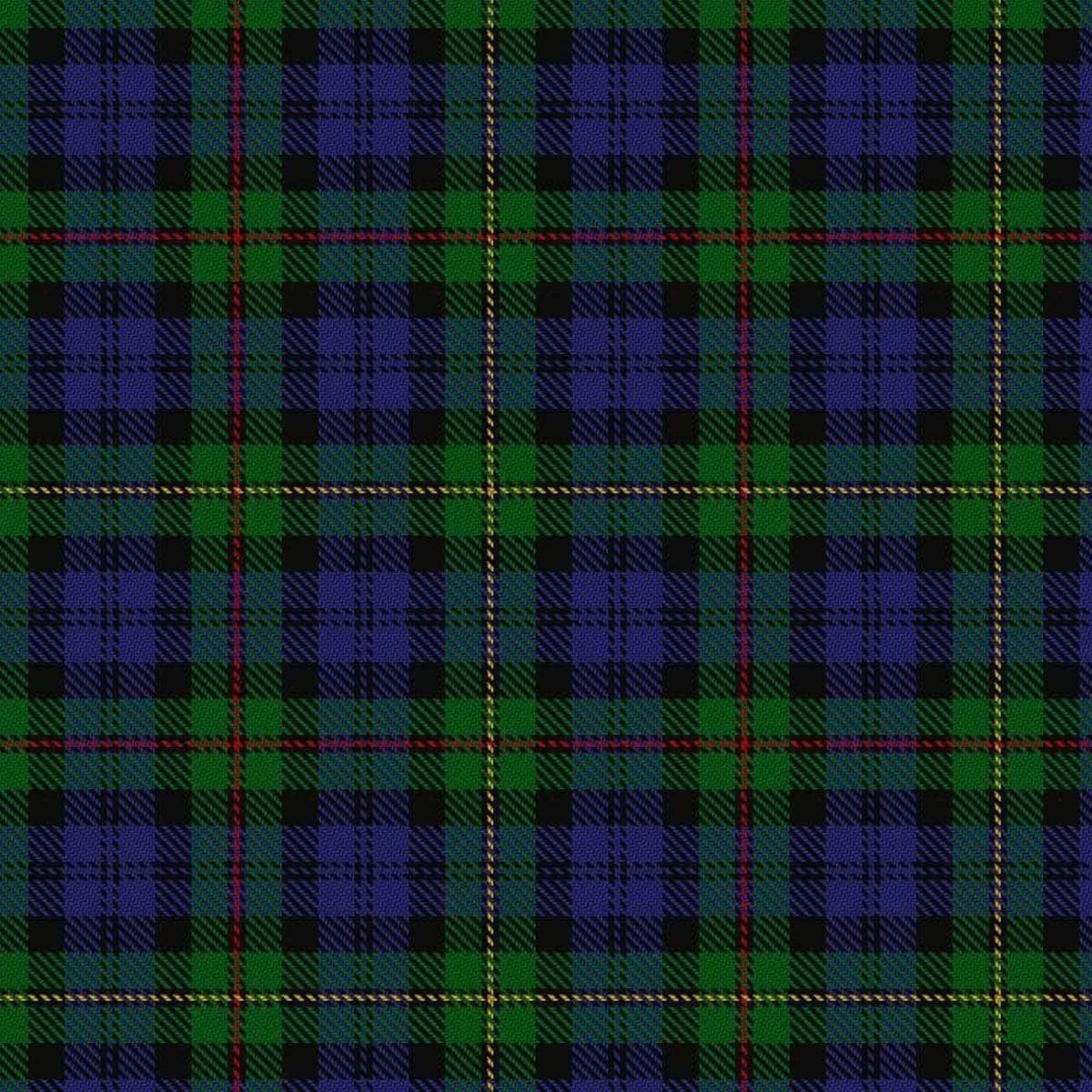
The MacEwen tartan
The MacEwen sett belongs to the Campbell and Black Watch family of patterns. It sits very close to Campbell of Loudoun, differentiated for MacEwen by red and yellow overstripes, with further resemblance to Farquharson and MacLeod of Harris; and that group of setts owes its origin to the post-rebellion output of Wilsons of Bannockburn. The standard sett is recorded at 1906. A further recording with heavier guard lines is a variant of the same design rather than another tartan. A separate and more elaborate arrangement of twenty-eight bands is recorded under the name Clans Originaux, after the French tartan compendium of that name, and is arguably a distinct sett; we could not confirm its date. MacEwen does not appear in the Vestiarium Scoticum.
A note on honesty: MacEwen Modern, Ancient, Weathered and Muted are colourways of the single 1906 sett, not separate tartans. No MacEwen sett predates the commercial era. That point has more force here than for most clans, because the MacEwens were landless and chiefless from the fifteenth century, long before setts were being named for families — so a MacEwen tartan worn at Otter, or anywhere else in the middle ages, is not a possibility. It is also worth saying rather than hiding that the sett’s closest relative belongs to the Campbells, the family that took Otter. As for the dating of the register’s entries, we were unable to retrieve them directly and have relied on threadcount records; the register’s search page is linked below.
Clan facts
| Chief | Sir John Roderick Hugh McEwen of Marchmont & Bardrochat, Bt, recognised 10th Chief of the Name and Arms of MacEwen by warrant of the Lord Lyon dated 20 March 2025, per the Clan MacEwen Society. He was selected by Family Convention, so his descent from the Otter line is not a documented unbroken succession |
|---|---|
| Motto | Reviresco — Latin, “I grow green again”, punning on the crest of a felled oak sprouting new branches. It is a nineteenth-century clan-revival adoption, not a medieval motto |
| Plant badge | Not recorded. The sprouting oak is the heraldic crest, not a bonnet sprig, and the clan society’s own crest-badge page gives no plant badge |
| Lands | Barony of Otter, east shore of Loch Fyne, Cowal, Argyll; seat Castle MacEwen near Kilfinan, now ruinous. Marchmont and Bardrochat are the present chief’s baronetcy properties, not ancient clan lands |