
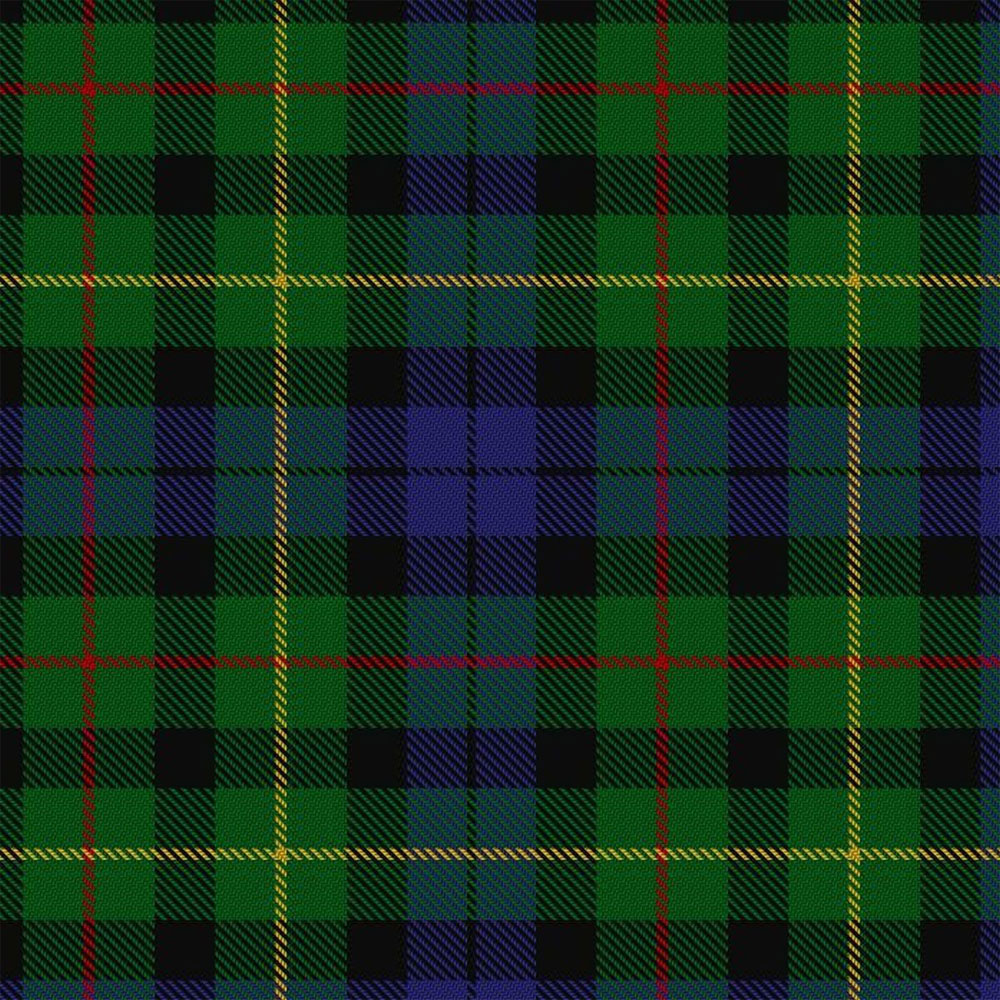
Clan Rollo
The descent from Rollo of Normandy, the Viking chieftain who died about 928, is tradition and not record. The link the sources actually make is etymological: Rollo is the Latinised form of the Old Norse Hrólfr, and Rollo of Normandy was the first notable bearer of the name. No charter connects the Scottish Rollos to the Norman duke, and local accounts of an Eric de Rollo coming over in 1066 are hedged in their own telling with “said to be”. The name appears in Scotland in a charter of 1141 granted by Robert de Brus. Robert Rolloche received lands in the Perth area from David II in 1369, and in 1380 John de Rollo received a charter for the lands of Duncrub — from the king according to one source, from David, Earl of Strathearn according to the Gazetteer for Scotland. On 26 August 1511 William Rollo of Duncrub had his lands erected into a free barony.
A William Rollo is believed to have been killed at Flodden in 1513. Sir William Rollo commanded the left wing of Montrose’s army at the Battle of Aberdeen in 1644 and was captured after Philiphaugh and beheaded in October 1645. Sir Andrew Rollo was created Lord Rollo of Duncrub at Perth on 10 January 1651 by Charles II. Andrew, 5th Lord, captured Dominica in 1759 and was made brigadier general the following year; Robert Rollo fought at Sheriffmuir in 1715. John, 10th Lord, was created Baron Dunning in the Peerage of the United Kingdom on 29 June 1869 and built a large mansion at Duncrub, the estate standing at some 10,148 acres in the 1880s. The present chief is David Eric Howard Rollo, 14th Lord Rollo and 5th Baron Dunning, who succeeded his father in 1997. The lordship has descended unbroken through fourteen holders with no forfeiture or attainder on record, so unlike many of its neighbours this chiefship has never been dormant and has needed no restoration.
The Rollo tartan
There is exactly one Rollo tartan on the Scottish Register of Tartans: Rollo, reference 3542, Clan/Family, with a design date of 1 January 1946, designed for Lord Rollo in that year. A second recording at a different scale is the same sett woven on different cloth, not another tartan. The pattern has a noted resemblance to Campbell of Breadalbane, which reflects shared Perthshire ground rather than any documented derivation. It is not from the Vestiarium Scoticum: Rollo is not among that book’s seventy-five tartans, and the register appends “(V.S.)” to Vestiarium setts, which this entry does not carry. Nor is it a Wilsons of Bannockburn pattern, since Wilsons ceased trading in 1868.
A note on honesty: with a single registered threadcount, every Rollo Modern, Ancient, Weathered or Muted on sale anywhere — here included — is a colourway of the 1946 sett and not a distinct tartan. No Rollo sett predates the commercial era, and this one does not even belong to the nineteenth century: it is a twentieth-century commission, so any claim of a Rollo tartan worn in the middle ages is simply false. One further correction, since it circulates widely: retail copy sometimes gives the family Erskine lands. We could find no source connecting the Rollos to Erskine at all, and the documented territorial designation is of Duncrub.
Clan facts
| Chief | David Eric Howard Rollo, 14th Lord Rollo and 5th Baron Dunning, born 1943, succeeded his father in 1997. We did not find the exact Lyon Court formula “Chief of the Name and Arms of Rollo” in a primary record, though the chiefship itself is not in doubt |
|---|---|
| Motto | La Fortune Passe Partout — French, “fortune passes everywhere”. The crest is a stag’s head couped proper |
| Plant badge | Not recorded. We found no reliable source and have not supplied one |
| Lands | Duncrub, near Dunning in Perthshire, historically, with early lands at Findo Gask; the present seat is Pitcairns House, Perthshire. No source gives a date for the break-up of the Duncrub estate |