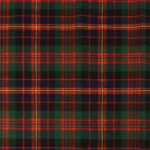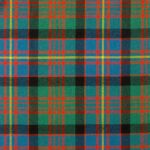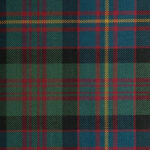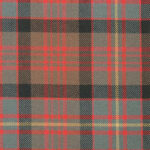
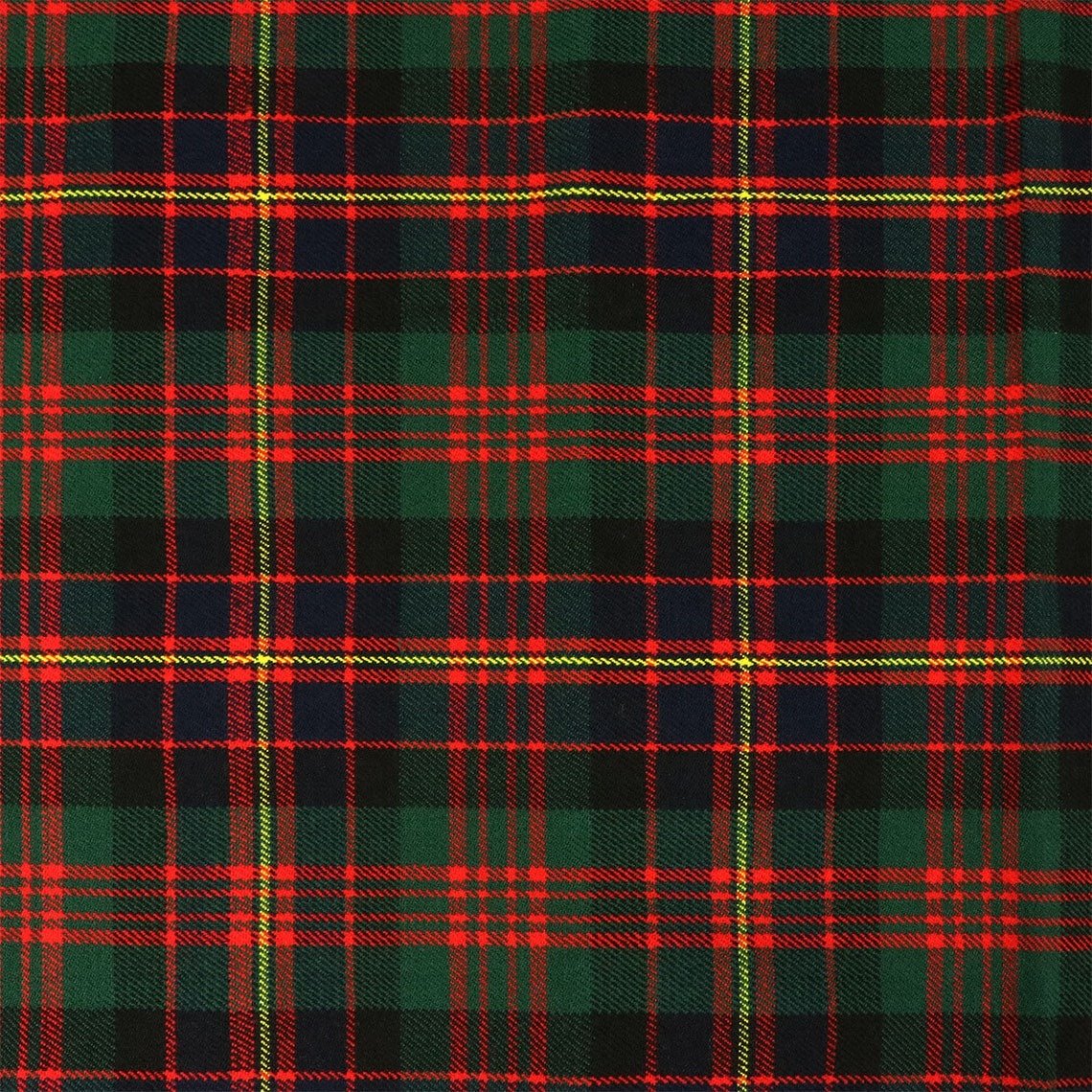
 Cameron Of Erracht Modern
Every other Highland regimental tartan is the Government sett with stripes added; this one is not, and the tradition is that a woman in Lochaber worked it out in 1793 so that her son’s new regiment would not have to borrow the Black Watch pattern.
Sliochd Eòghain mhic Eòghain
Erracht lies on the north side of Loch Lochy in Lochaber, and its family is a cadet branch of Clan Cameron founded in the sixteenth century by Ewen, a son of Ewen Mòr Cameron, thirteenth of Lochiel, and Marjory Mackintosh. The Gaelic name of the branch, Sliochd Eòghain mhic Eòghain, means the children of Ewen son of Ewen. Its early record is violent even by Lochaber standards, and the violence runs inside the clan rather than outside it: a son of the founder, John Dow, was executed around 1585 for the killing of Donald Dubh Cameron in 1569, and the third of Erracht was put to death on the orders of Cameron of Lochiel in 1613.
Donald Cameron, seventh of Erracht, was second in command of the Camerons at Glenfinnan in 1745 when the standard was raised, fought through the campaign, and spent three years as a fugitive after Culloden before re-establishing himself.
A cadet branch that raised a regiment
Donald’s eldest son, Alan Cameron of Erracht (1753–1828), raised the 79th Regiment of Foot at his own expense in 1793 after war was declared with France. That he could do so at all was irregular: the other Highland corps of the period were raised by clan chiefs with the tenantry behind them, and Alan Cameron was chieftain of a cadet branch, not of Clan Cameron. The regiment served in Flanders in 1794 and 1795 and the first corps was broken up in 1797; Cameron raised a second 79th in 1798, some 780 strong. It became the Queen’s Own Cameron Highlanders. Cameron died at Fulham on 9 March 1828.
Who designed it, and from what
The attribution is consistent across the regimental and clan accounts and is nonetheless tradition rather than a document: the sett was worked out by Alan Cameron’s mother. She was Marjory, in Gaelic Marsali, a daughter of MacLean of Drimnin, and the accounts add that her own father was killed at Culloden. The reason given for designing something new is practical. The existing Cameron pattern was judged too red to sit well against the scarlet coats of the period, and using the Government sett as a ground, which is what every other Highland regiment did, would have made the new corps look like a detachment of somebody else.
What she drew on is where the accounts part company. One line of explanation holds that she combined Cameron elements with a MacDonald arrangement, reflecting the old MacDonald overlordship in Lochaber, and some versions name MacDonell of Keppoch specifically. Another holds that she used her own family’s pattern. The Keppoch version sits awkwardly with the record that she was a MacLean of Drimnin rather than a MacDonell, and no contemporary paper settles the question. What can be said is that the result is visibly a yellow-striped sett on a dark ground rather than a variation of the red Cameron pattern, and that it is not built on the Government check.
That last point is the branch’s strongest claim on the history of military tartan. The Highlanders’ Museum at Fort George states that this is the only tartan in the British Army that does not have the Government, or Black Watch, sett as its backing.
Erracht and Lochiel side by side
The Scottish Register of Tartans lists Cameron of Erracht as reference 495, with a dress version at 496, alongside the separate Cameron of Lochiel patterns. Lochiel is the older design of the two, traced to a portrait of Donald Cameron of Lochiel painted in 1764, though the sett in the painting differs slightly from the modern weave; Wilsons of Bannockburn were producing a version of it in the early nineteenth century. The plain Cameron sett came out of the Vestiarium Scoticum, the 1842 volume now accepted as a forgery, where it is described as four green stripes on a scarlet field. The weathered rendering of Erracht is a twentieth-century addition, developed in the 1950s from a cloth fragment said to have been recovered from a battlefield; as with Modern, Ancient and Muted, it is a dye convention rather than a different sett.
The question of entitlement
Camerons and the names associated with the clan may wear it without asking, as may descendants of the Erracht family and of the men who served in the 79th and its successors. There is no restriction, and the pattern has long been worn well beyond Lochaber. Because its whole point was to be unlike the Government sett, it also reads very differently from any of the Black Watch derivatives at a distance.
References
Wikipedia, Cameron of Erracht, and Alan Cameron of Erracht; The Highlanders’ Museum, Sir Alan Cameron of Erracht; Kinloch Anderson, Cameron of Erracht; ScotClans, Clan Cameron Tartans; Scottish Register of Tartans (refs 495, 496, 498).