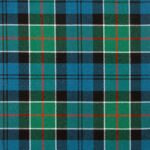
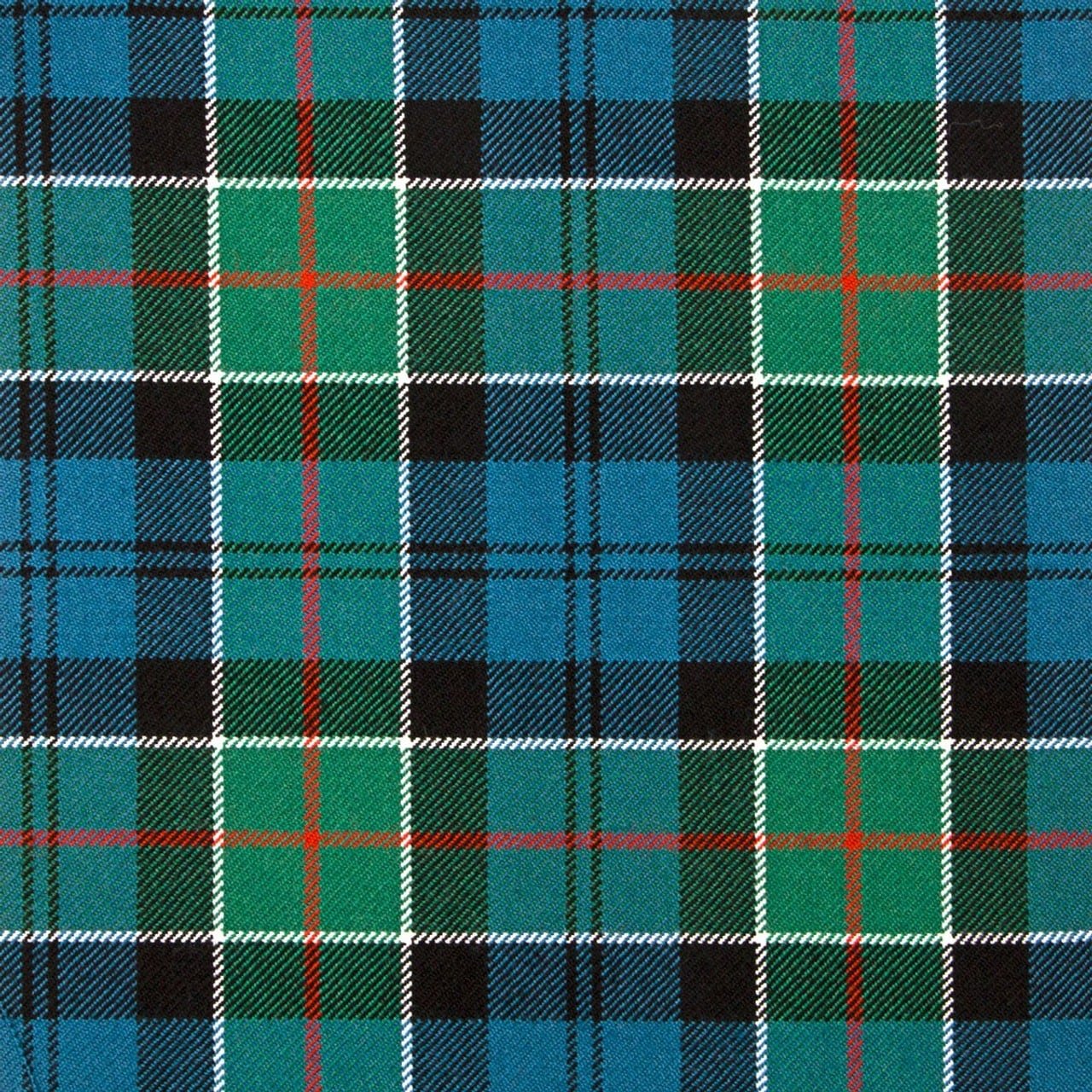
 Colquhoun Ancient
Most clan setts rest on a weaver’s pattern book; this one rests on a sample the chief sealed and signed for the Highland Society of London on 29 May 1817.
Kilpatrick before Colquhoun
The name is territorial, taken from lands on the north shore of the Clyde rather than from a person. In the reign of Alexander II, Umphredus de Kilpatrick received from Malduin, Earl of Lennox, the estates of Colquhoun, Auchentorlie and Dumbuck, and his descendants took their surname from the first of them. The early stronghold was Dunglass Castle, on a rock above the Clyde within sight of the royal castle of Dumbarton, which placed the family on one of the more sensitive stretches of water in the kingdom.
Luss, and the barony
The family’s standing changed with a marriage. About 1368 Sir Robert of Colquhoun married the heiress of the Lord of Luss, and the chiefly designation has been Baron of Luss ever since. The line was not a quiet one: Sir John Colquhoun, governor of Dumbarton Castle during the minority of James II, was killed in a raid at Inchmurrin in 1439. His successor, another Sir John, obtained a charter in 1457 incorporating his lands into the free barony of Luss, and in the following year added the forests of Rossdhu and Glenmachome together with the lands of Kilmardinny. In 1625 Sir John Colquhoun of Luss was created a baronet in the Baronetage of Nova Scotia. Rossdhu, built later by Sir James Grant Colquhoun, remains the seat, and the present chief is Sir Malcolm Rory Colquhoun of Luss, eighth Baronet, who succeeded his father in 2008. The motto is Si je puis, if I can, and the crest a stag’s head.
Glen Fruin, 1603
The event the name is best remembered for went badly. On 7 February 1603 Alasdair MacGregor came into Colquhoun country with a force put at over four hundred men. The Colquhouns, who held a royal commission against the MacGregors, turned out a much larger body, reckoned at some five hundred foot and three hundred horse. MacGregor divided his men, engaged from the front and attacked from behind, and drove the Colquhouns into wet ground where cavalry counted for nothing; more than two hundred were killed. The consequence fell on the victors rather than the defeated, since in April 1603 James VI ordered the MacGregor name abolished altogether. The quarrel was eventually laid down in person: at the end of the eighteenth century the chiefs of the two clans met on the ground where the killing had happened and shook hands. A commemorative pattern named Fruin Colquhoun was woven by Lochcarron and is dated 1998 in the Scottish Tartans Authority records, though no designer’s note survives with it.
The sett, and the Cowans
Colquhoun is one of the better documented clan patterns. It appears in the earliest collections, including the Cockburn Collection of 1810, and the sample certified by the chief with his seal and signature is preserved in the archives of the Highland Society of London under the date 29 May 1817. The form now worn was woven by Wilsons of Bannockburn early in the nineteenth century and set down in the firm’s pattern book of 1819; the earliest date D. C. Stewart could draw from the Wilsons correspondence for the name is 1822, which is a reminder that the pattern books and the letters do not always agree. Proportions differ noticeably between surviving woven samples, so the design should be thought of as a pattern with a settled sequence of colours rather than one fixed recipe.
William and Andrew Smith of Mauchline, in their book of 1850, accepted the sett on the ground of custom and the agreement of the authorities they had consulted, and added that it was also the proper tartan of the Cowans, whose name they took to be nothing more than a worn-down Colquhoun. A dress version, noted by the Scottish Tartans Society in January 1984, was produced by Johnstons of Elgin around 1960 and is asymmetric, which is unusual enough to be worth knowing before buying one.
Who ends up wearing it
There is a recognised chief, so the sett has a living authority behind it. Anyone of the name, in any of its spellings, and anyone descended from a Colquhoun line may wear it. The Smiths’ point brings the Cowans in as well, and the MacLintocks are claimed as a dependent family by Colquhoun, although Clan MacDougall claims them too and the matter is not resolved.
References
Clan Colquhoun, Wikipedia; Clan Gregor and the proscription of 1603, Wikipedia; Scottish Tartans Authority, tartan ferret records for Colquhoun, Colquhoun Dress, Fruin Colquhoun and MacLintock, citing Scottish Tartans Society notes, the Cockburn Collection and the Highland Society of London; William and Andrew Smith, The Clan and Family Tartans of Scotland, 1850; Peter Eslea MacDonald, The Development of Clan Tartans, scottishtartans.co.uk.