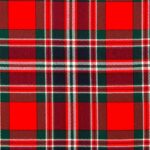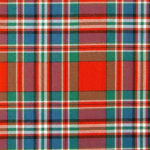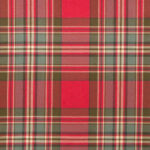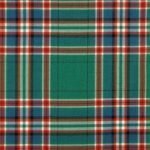
 MacFarlane Modern
Clan MacFarlane
Clan MacFarlane, in Gaelic Clann Phàrlain, takes its name from Pàrlan, son of Malduin, the personal name usually explained as a Gaelic form of Bartholomew. Older writers linked Pàrlan to Partholán of the Irish legends; later linguistic work treats both as survivals from a pre-Gaelic language, and the mythological connection is not evidence of anything. The clan descends from the Celtic Earls of Lennox: Gilchrist, youngest son of the second Earl, obtained the barony of Arrochar by charter bearing the seal of Alexander II. The MacFarlane country lay in the Highlands between Loch Long and Loch Lomond, with the same boundaries as the parish of Arrochar, running up the western shore of Loch Lomond from Tarbet. The slogan Loch Sloy comes from the small loch under Ben Vorlich where the clan mustered.
The MacFarlanes were fighters and, for a long stretch, cattle-raiders. The clan society records the eleventh chief falling at Flodden in 1513, though that episode does not appear in every account. At Pinkie in 1547 Duncan, thirteenth chief, was killed along with his uncle and many of his men. At Langside in 1568 Andrew MacFarlane came in with three hundred of his friends, turned a flank of Mary’s army and took three royal standards; the motto This I’ll Defend is said to have been awarded after that day. The clan raided its neighbours, particularly the Colquhouns, by night so persistently that the full moon was known in the district as MacFarlane’s Lantern. At Glen Fruin in 1603 MacFarlanes were present with the MacGregors when around eighty Colquhouns were killed, and the trials that followed scattered the clan: by 1624 many had been removed to Aberdeenshire and to Strathaven in Banffshire. The ancestral lands were sold for debt in 1767. William MacFarlane, twentieth chief, born 1813, died in 1866 without issue, and no one since has rematriculated the chiefly arms.
The MacFarlane tartan
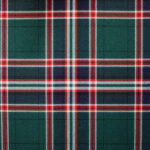
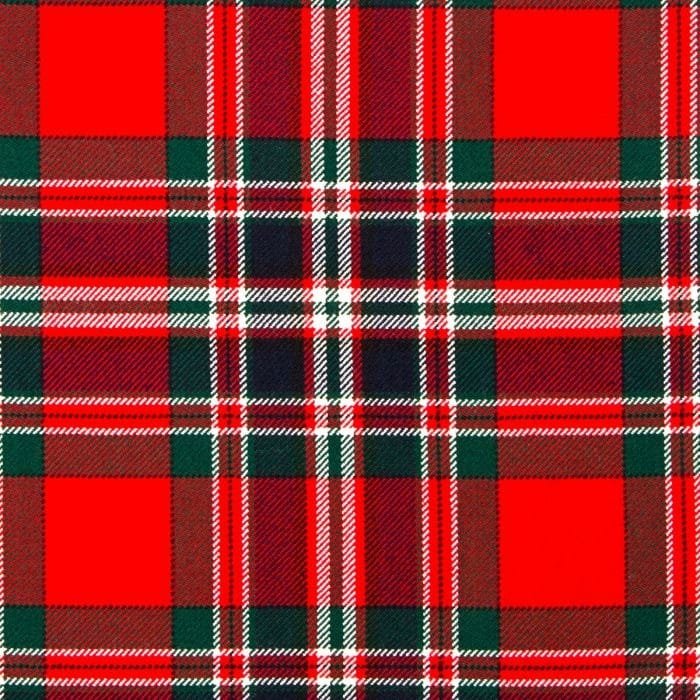
The Scottish Register of Tartans returns exactly four results for MacFarlane, which is a small number for a well-known name. They are MacFarlane Dress, MacFarlane Hunting, MacFarlane or Lendrum (Black & Red), which the Register files under Fashion and shares with a second surname, and MacFarlane Red. Only MacFarlane Red carries a named source, and that source is Wilsons of Bannockburn, the Stirlingshire firm whose pattern books supplied most of the tartan trade from the late eighteenth century onwards. The other three records list no designer and no date.
That makes MacFarlane Red the documented MacFarlane sett. It is the one with a traceable weaver behind it rather than an anonymous Victorian entry, and it is the pattern most MacFarlane kilts are cut from.
A note on honesty: there is no record in the Register for a plain tartan called simply “MacFarlane”, and none at all for MacFarlane Ancient, MacFarlane Modern or MacFarlane Weathered. Those three names describe dye recipes, not setts — the same threadcount woven in bright chemical shades, in the lighter tones meant to imitate vegetable dyes, or in muted colours meant to look aged. A shop offering you four MacFarlane tartans is offering you one or two patterns in four colourways. And the pattern itself is a commercial weaving-trade design of the decades after the 1745 rising, sold by a Stirlingshire firm to a market that wanted clan tartans. The MacFarlanes who fought at Langside in 1568 did not wear it.
Clan facts
| Chief | None. Clan MacFarlane is armigerous and the chiefship has been dormant since the death of William MacFarlane, 20th Chief, in 1866. The clan society states plainly that there is no Clan Chief; it holds its own grant of arms from the Court of the Lord Lyon, made in 2000 |
|---|---|
| Motto | This I’ll Defend |
| Slogan | Loch Slòigh — “Loch Sloy”, the Loch of the Host, under Ben Vorlich |
| Plant badge | Cranberry, shared with Clan MacAulay. The historian Skene gives cloudberry instead, and the two are still cited against each other |
| Lands | Arrochar, between Loch Long and Loch Lomond; the western shore of Loch Lomond above Tarbet. Sold for debt in 1767 |