
Clan Muir
Muir is a descriptive name rather than a territorial one: a person living by a moor, Scots muir, which is why it appears in many places and in many spellings — Muir, Mure, More and the Scottish Moore among them. The Irish Moore, Ó Mórdha, is a different family altogether and should not be merged with it. The earliest dated record is David de More, witness to a charter of Alexander II between 1214 and 1249, and the oldest recorded line is the Mores of Polkelly, near Kilmarnock in Ayrshire. Sir Gilchrist Mure is said to have fought at the Battle of Largs on 2 October 1263, and the account of him as the first Mure holder, buried in the Mure Aisle at Kilmarnock, is treated even by sympathetic sources as family tradition.
Adam, Gilchrist and Reginald appear in the Ragman Roll about 1296, and Thomas de la More was an executor of Dervorguilla de Balliol’s will in 1291. Elizabeth Mure was mistress and then wife of Robert the Steward, later Robert II; their marriage dispensation dates to 1347 and she died before 1355. John Mure of Rowallan was killed at Flodden in 1513 and Sir Mungo Mure at Pinkie in 1547. John Mure built the south front of Rowallan Castle about 1562, a dated stone of 1616 sits over the gateway, and Sir William Mure was wounded at Marston Moor in 1644. Rowallan in Ayrshire was the principal seat, with branches at Caldwell, Auchendrane, Thornton and Glanderstoun. Sources conflict over when the Rowallan line ended: one makes Sir William Mure, who died in 1657, the sixteenth and last Mure of Rowallan; another has the last laird dying without a male heir in 1700. The estate passed through the heiress Dame Jean Mure to the Boyle Earls of Glasgow, then the Campbell Earls of Loudoun, then the Corbett Barons Rowallan.
The Muir tartan
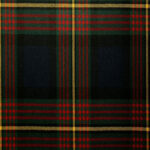
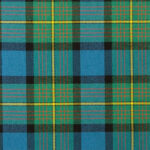
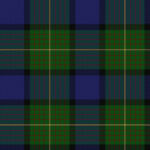
There is one Muir sett, recorded under the joint name Muir/Moore: a blue-ground pattern of 376 threads. Its dating needs care. The Scottish Register of Tartans gives the date as 1 January 1880 and names no maker and no source. The Scottish Tartans Authority notes the earliest known date as 1930, with 1880 in brackets, because the threadcount comes from John MacGregor Hastie’s collection, gathered between 1930 and 1950, and the tartan was published in John Ross’s Land of the Scottish Gael in 1930. Samples are held in the Authority’s Dalgety Collection. The honest formulation is that the sett is dated 1880 in the register and first documented in 1930 — not that it is ancient. We could not open the register’s own detail pages, so no reference number is printed here.
A note on honesty: Muir Modern and Muir Ancient are colourways of that one sett, not two tartans, and the separate tartandictionary entry under Muir (Clan) is the same 376-thread count recorded with different colour codes. No Muir sett predates the commercial era, and none of the sources we checked links it to Wilsons of Bannockburn or to the Vestiarium Scoticum. The Clan Muir Society has itself said that the name was historically absorbed as a sept by the Gordons, Campbells, Donalds and Stewarts, while now presenting Muir as an independent clan; John Muir’s 1945 biographer placed him in Clan Gordon without evidence. The California state tartan was modelled on the Muir sett but is a separate tartan.
Clan facts
| Chief | None. Muir is an armigerous clan with no chief recognised by the Lord Lyon; the last was Mure of Rowallan. A society named Andrew Moore “Head of the House of Muir” in 2000, which was not a recognition by the Lord Lyon |
|---|---|
| Motto | Durum patientia frango — “I overcome difficulty by patience”, literally “by patience I break what is hard” |
| Plant badge | Not reliably recorded. The rowan is widely given but we found no sourced authority for it |
| Lands | Rowallan Castle, Ayrshire, the principal seat, now privately owned; Polkelly near Kilmarnock; branches at Caldwell, Auchendrane, Thornton and Glanderstoun |