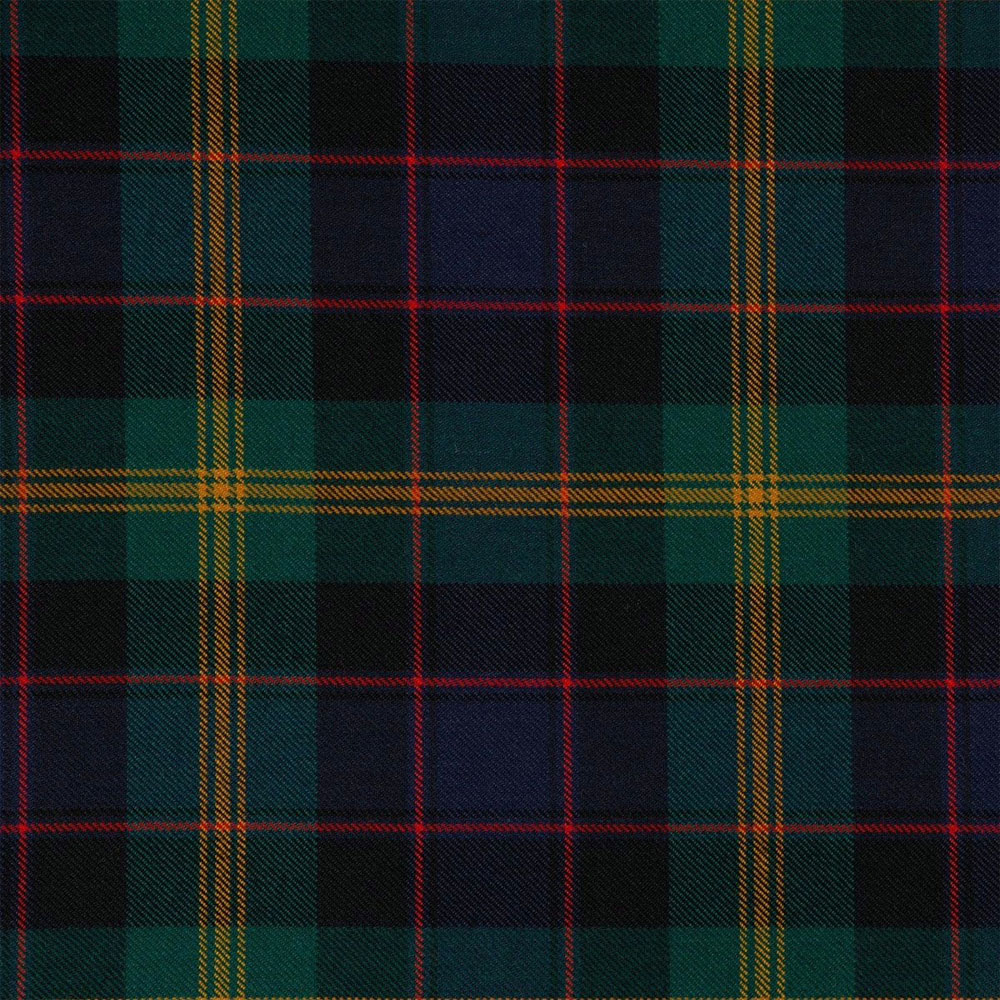
 Watson Modern
Clan Watson
Watson is a patronymic: son of Watt, Watt being a diminutive not of Watson but of Walter. Because the name was formed independently wherever that forename was common, it has no single origin and no common ancestor — a point worth making plainly, since it is also a Lowland name, of Edinburgh, Midlothian and the Borders and later of the north-east, and there is no evidence of Watsons ever forming part of the Highland clan system. The claim that the name came to Scotland in the early eleventh century, in the reign of Edward the Confessor, is asserted without record and is chronologically loose; treat it as tradition.
The dated records are good. Robert II re-granted the lands of Cranstonriddel to William Watson in 1384; a John Watson is recorded owning lands in Edinburgh in 1392; William Watson of Cranston obtained a Crown charter of Traquair and Shillinglaw in 1407; Thomas Watson of Stenhous was party to an inquest near Falkirk in 1426; and Sir Donald Watsone appears in the Moray records in 1493. The chiefly line begins with Richard Watson, recorded as proprietor of Saughton House in 1537. David Watson of Saughton recorded chiefly arms in 1672 — argent, an oak tree growing out of a mount in base proper, surmounted of a fess azure. Charles Watson of Saughton was referred to in print as Chief of the Name in Scotland in 1794, and James Watson of Saughton matriculated arms as such on 3 June 1818. He died in 1823 and the chiefly male line failed with him; his daughter Helen married Sholto John Douglas, 18th Earl of Morton.
Watson is an armigerous clan with no chief and no commander. In May 2024 the Council of Scottish Clans and Associations reported that the Watson society was surveying its members on whether to open discussions with the Lord Lyon about appointing a commander — a step that must precede the appointment of a new chief. The most senior eligible heir identified by research has indicated he will not petition, and the Douglas line has likewise declined. One older source claims that Watson is recognised as an independent clan by the Standing Council of Scottish Chiefs; that body admits only chiefs and commanders, and Watson does not appear on its membership list, so we prefer the current list.
Watson is claimed as a sept by both Clan Buchanan and Clan Forbes, and both claims are thinner than they look. The Buchanan claim traces to William Buchanan of Auchmar’s genealogy of 1723, by way of Walter, son of John Buchanan of Leny, who used the form MacWattie — but that paper never mentions Watson at all, and speculates only that such names may derive from the line. The Buchanan Society, founded in 1725, recognises three septs and Watson is not among them; the listing of Watson begins with Clan Buchanan Society International, founded in 1970, the earliest verifiable reference being 1980. Clan Buchanan’s own page concedes that only genealogical or DNA research can tell a Watson which line they belong to. The Forbes association rests on Watson settlement in Aberdeenshire, for which we found no primary authority at all. Neither listing rests on a chief-to-chief agreement or on any record naming Watson.
The Watson tartan
There is one Watson family sett, a blue-ground pattern recorded with a date of 1932. Its designer and date are disputed three ways: one account gives it to the Rev. Mhuir Watson in 1932, another to the Rev. Mhuir Watson of Glamis Church in 1935, and a third dates it to 1950, designed for the Clan Watson Society and based on the Gordon and Hunting MacRae tartans. The 1932 date has the best support, appearing in two sources and in the register record; the attribution to Rev. Mhuir Watson appears only in secondary sources and we have not been able to confirm it. A second, unrelated Watson threadcount dated 2001 exists in the tartan dictionary with no designer and no register reference; its status is unclear and it should not be taken for the Watson tartan.
A note on honesty: Watson Modern, Ancient, Weathered and Muted are colourways of the single 1932 sett, not four tartans, and there is no documented Watson Dress or Watson Hunting sett at all. No Watson sett predates the commercial era — the tartan is a twentieth-century design, it appears nowhere in the Vestiarium Scoticum, and there is no Wilsons of Bannockburn attribution, so any claim of a Watson tartan before 1800 is unsupported. George Watson’s College, Watson Kirby and Barton-Watson de Bavidge are an institutional tartan, a separate family sett and a personal tartan respectively, and none of them is Clan Watson’s. Watsons who accept the sept claims commonly wear Buchanan or Forbes; since the name has a sett of its own, that is a choice rather than a necessity.
Clan facts
| Chief | None — vacant since 1823. The last was James Watson of Saughton, arms matriculated 3 June 1818, styled Chief of the Name in Scotland. Watson is armigerous; no commander has yet been appointed |
|---|---|
| Motto | Insperata floruit — “it has flourished unexpectedly”. Some retailers misspell this as Inspirata floruit |
| Plant badge | Not recorded. Retailers that supply one are either inventing it or importing Buchanan’s or Forbes’s |
| Lands | Saughton House, now within Edinburgh, held by Watsons from 1537 and the chiefly seat; earlier Cranstonriddel (1384), Traquair and Shillinglaw (1407) and Stenhous (1426). A Lowland name: no Gaelic patronymic is recorded |