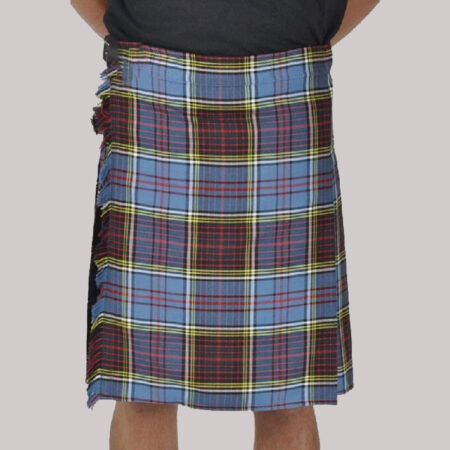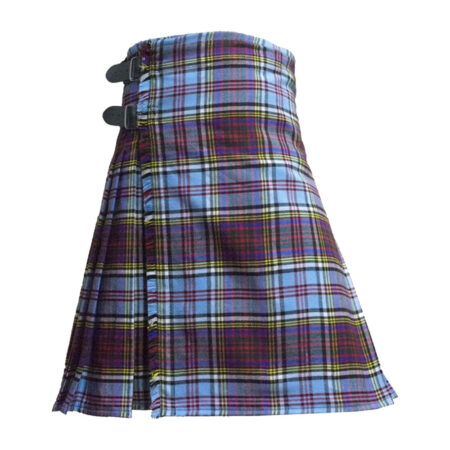
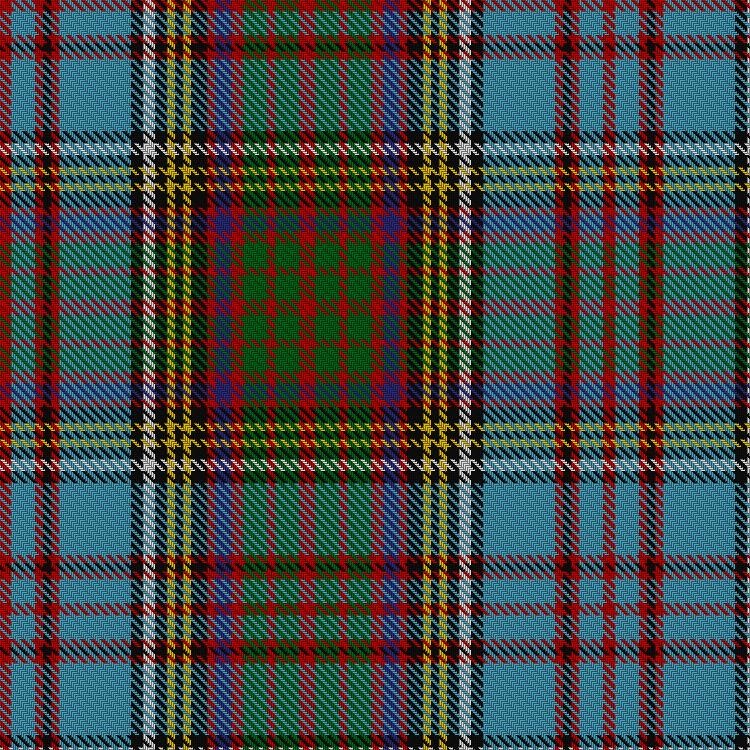
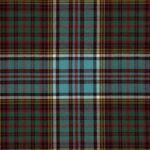
 Anderson Modern
Clan Anderson
Anderson means son of Andrew, and because Andrew is Scotland’s patron saint the name arose separately in many places rather than spreading outward from one. The Gaelic forms are Gilleaindreas and Mac Ghille Aindrais, servant of Andrew. In the Highlands the same root gives MacAndrew, Mac Aindrea, borne by a family settled in Badenoch under Mackintosh protection and counted within the Clan Chattan confederation. Andersons are recorded thickly across the north-east — Aberdeenshire, Banff and Moray — and just as thickly in the Lowland burghs, where the name-scholar George Fraser Black found them as burgesses of Peebles and Dumfries through the sixteenth and seventeenth centuries. The historian Ian Grimble concluded that although arms were granted to an Anderson of that Ilk in the sixteenth century, the name is so widespread that no exact place of origin can be established. Anderson has no clan country in the way a Highland clan has one, and honest accounts of the name say so.
What survives is a scatter of dated records rather than a single clan narrative. James Anderson of Sterheuch was appointed Carrick Pursuivant of Arms in 1526. The Forman-Workman manuscript of 1566 sets down arms for Anderson of that Ilk, though who that person was has never been established. Patrick Anderson acquired Candacraig in Strathdon in the mid-sixteenth century, and Stobcross, Inchyra, Wyseby, Ardbrake, Kinneddar and Westerton all carry Anderson lines. Alexander Anderson, born in Aberdeen about 1582 and dead in Paris about 1620, was chosen by the executors of François Viète to edit and extend Viète’s manuscripts, publishing six volumes of algebra and geometry between 1612 and 1619. John Anderson, born at Rosneath in 1726 and dead in Glasgow on 13 January 1796, left his property to found a Glasgow school of “useful learning”; Anderson’s Institution passed through mergers and renamings into the University of Strathclyde. In 2014 the Court of the Lord Lyon granted arms to the Clan Anderson Society, the letters patent presented by Dr Joseph Morrow at the Loch Norman Highland Games in North Carolina.
The Anderson tartan
A search of the Scottish Register of Tartans for Anderson returns forty-seven results, more than for most names of comparable size. The principal entry is simply Anderson, listed under Clan/Family, with no designer and no date recorded. Beside it sits a separate record, Anderson (Highland Society of London), from the collection of certified clan setts the Society gathered from the 1810s onward — the earliest documentary anchor the Anderson pattern has.
The rest of the forty-seven are mostly recent. David Waterton-Anderson designed Anderson of Ardbrake and Anderson of Kinneddar Hunting; Peter MacDonald recorded Anderson of Kinnedear Red. There are collector and weaver variants attached to names such as Coulson Bonner, MacGregor-Hastie, Paton and W. L. Anderson of Stirling. Anderson Blue and Anderson Green are fashion setts from West Coast Woolen Mill, and there is a separate Anderson Blue by Vivienne Westwood. An Anderson Dress sett is recorded, and a corporate tartan for Anderson Maguire Funeral Directors designed by Brian Wilton in 2022.
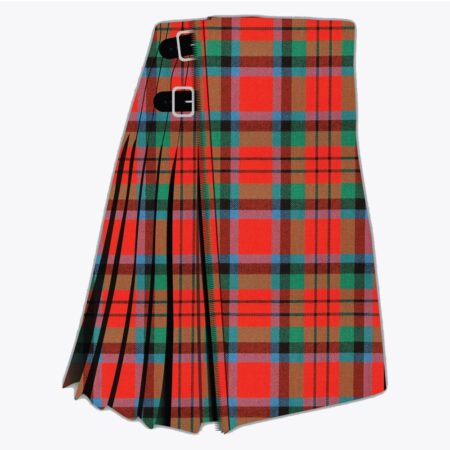
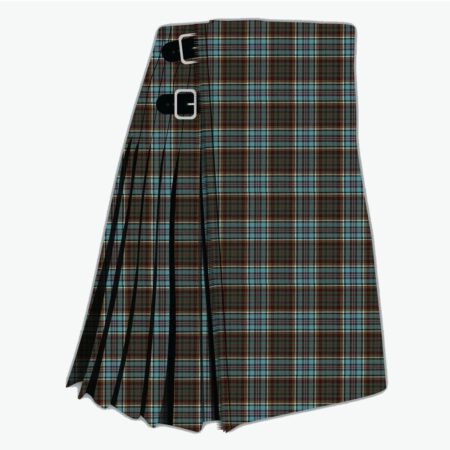
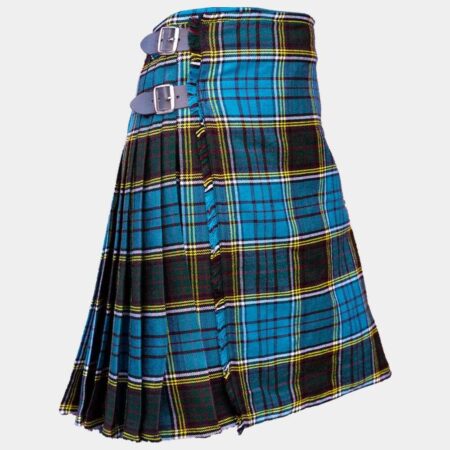
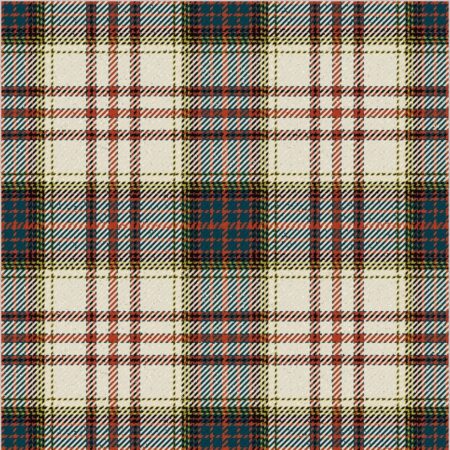
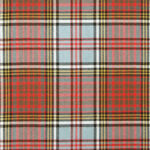
A note on honesty: Anderson Ancient, Anderson Modern and Anderson Weathered are not three tartans. The Register holds no record under any of those names. They are the one Anderson threadcount woven in different dye recipes — brighter chemical shades, lighter vegetable-dye shades, or muted ones meant to suggest age. Nor is there any Wilsons of Bannockburn record for Anderson, so the sett cannot be traced to that firm’s eighteenth-century pattern books the way many clan tartans can. What the Anderson sett is, on the evidence, is a pattern attached to a very common surname during the nineteenth-century tartan trade and afterwards. It is a good tartan. It is not a badge of Highland descent, and anyone selling it as one is selling you something the record does not support.
Clan facts
| Chief | None. Clan Anderson is armigerous and has no chief recognised by the Lord Lyon. The Clan Anderson Society, a North American body, received a grant of arms from the Court of the Lord Lyon in 2014; its head is styled Chieftain of the Society, not chief of the name |
|---|---|
| Motto | Stand Sure |
| Plant badge | Oak |
| Lands | No single clan territory. Andersons are concentrated in Aberdeenshire, Banff and Moray, and in the Lowland burghs; the MacAndrew line settled in Badenoch under Mackintosh protection |
References
Versions of the Anderson tartan
Anderson kilts & outfits
Every piece below is made to measure by Kilt 4 Less in the Anderson tartan. Choose a product, then pick your size and options.
Anderson of Arbrake Tartan Kilt
Original price was: £241.80.£159.00Current price is: £159.00.View kiltAnderson Weathered Tartan Kilt
Original price was: £241.80.£159.00Current price is: £159.00.View kiltAnderson of Ardbrake Modern Tartan Kilt
Original price was: £241.80.£159.00Current price is: £159.00.View kiltAnderson Arisaid Ancient Tartan Kilt
Original price was: £241.80.£159.00Current price is: £159.00.View kiltMen’s 8 Yard Prince Charlie Kilt Outfit
Original price was: £499.00.£315.00Current price is: £315.00.ConfigureMcCalls Highland Kilt Outfit With Argyll Jacket
Original price was: £510.00.£325.00Current price is: £325.00.ConfigureScottish Wedding Men Kilt Outfit
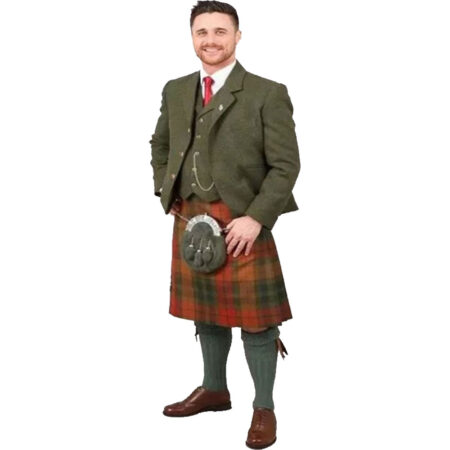
Original price was: £700.00.£304.00Current price is: £304.00.ConfigureForest Green Tweed Jacket Kilt Outfit
Original price was: £489.00.£249.99Current price is: £249.99.Configure