Clan Forsyth
The Forsyth surname is on record in Scotland from the late thirteenth century. The earliest firmly documented bearer is William de Fersith of Peebles, who swore fealty to Edward I in 1296 on the Ragman Rolls. Shortly after 1306, Osbert, son of Robert de Forsyth, held lands at Sauchie in Stirlingshire under Robert the Bruce, with a confirmation under the great seal recorded in 1320. The derivation of the name is genuinely disputed — a Gaelic origin from Fearsithe, “man of peace”, is one proposal and a Norman de Fronsac descent another — and both should be read as tradition rather than proven record.
The family settled around Stirling, supplying burgesses and civic officers, and branches acquired Nydie in Fife from about 1434, Dykes in Lanarkshire before 1488, and later Inchnock in Monkland, where a castle was built around 1585. Forsyths appear among the dead at Flodden in 1513, and in 1538 John Forsyth was appointed the king’s macer and later Falkland Pursuivant. The chiefship then lapsed for roughly three centuries in the late seventeenth century — sources disagree on whether the cause was a failure to appear when Charles II instituted the public register of arms in 1672 or a refusal of allegiance to William III in 1692. Revival efforts began in 1913, and after genealogical proof the Lord Lyon recognised Alistair C. W. Forsyth as chief, with his inauguration held at the Palace of Falkland in Fife in March 1979.
The Forsyth tartan
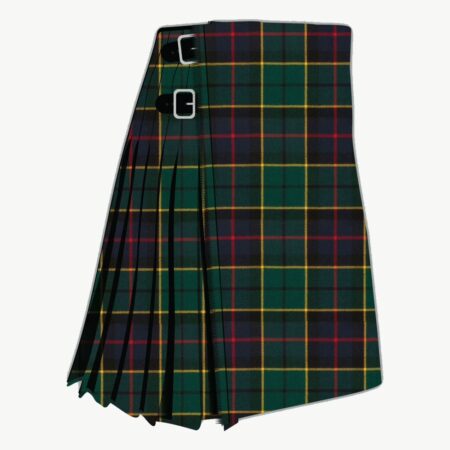
The Scottish Register of Tartans holds only two Forsyth clan setts: one recorded simply as Forsyth, and one recorded as Forsyth (1795) with the designer given as William Forsyth. Both carry no recorded date in the Register itself — they were carried across from earlier tartan collections when the statutory Register opened in 2009, so the Register does not independently evidence an eighteenth-century origin.
A note on honesty: there is no recorded Forsyth Hunting, Dress, Weathered or Ancient sett. What is sold under those names is the same threadcount in different dye shades. No Forsyth sett is attributed to the Vestiarium Scoticum or to Wilsons of Bannockburn. The story often attached to the 1795 sett — connecting William Forsyth, a Huntly merchant, to the Duchess of Gordon and the raising of the Gordon Highlanders — we could not verify against an authoritative source, so we do not repeat it as fact.
Clan facts
| Chief | Forsyth of that Ilk; chiefship recognised by the Lord Lyon in 1978, inaugurated at Falkland Palace in March 1979 |
|---|---|
| Motto | Instaurator Ruinae — “A repairer of ruin” |
| Crest | A griffin segreant azure, armed and membered sable, crowned Or |
| Plant badge | Forsythia — though this is a modern heraldic association rather than a historic Highland plant badge: forsythia is an East Asian shrub, named after the royal gardener William Forsyth and introduced to Britain only in the nineteenth century |
| Lands | Sauchie in Stirlingshire, Dykes and Halhill in Lanarkshire, Nydie in Fife, Inchnock in Monkland; present seat Ethie Castle, Angus |
References
Forsyth kilts & outfits
Every piece below is made to measure by Kilt 4 Less in the Forsyth tartan. Choose a product, then pick your size and options.
Clan Forsyth Ancient Tartan Kilt
Original price was: £241.80.£99.00Current price is: £99.00.View kiltMen’s 8 Yard Prince Charlie Kilt Outfit
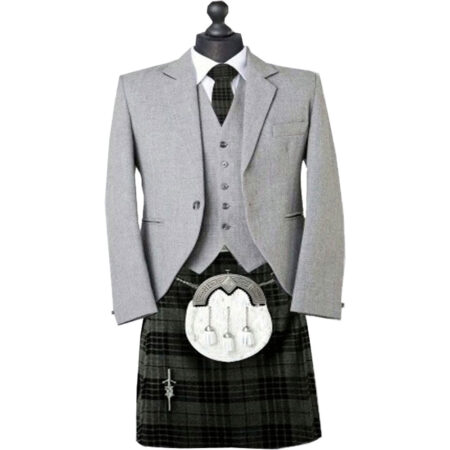
Original price was: £499.00.£315.00Current price is: £315.00.ConfigureMcCalls Highland Kilt Outfit With Argyll Jacket
Original price was: £510.00.£325.00Current price is: £325.00.ConfigureScottish Wedding Men Kilt Outfit
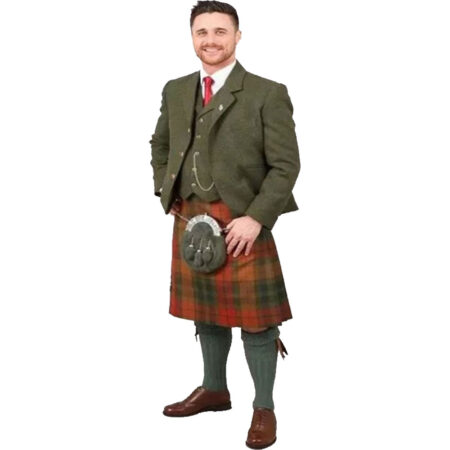
Original price was: £700.00.£304.00Current price is: £304.00.ConfigureForest Green Tweed Jacket Kilt Outfit
Original price was: £489.00.£249.99Current price is: £249.99.Configure