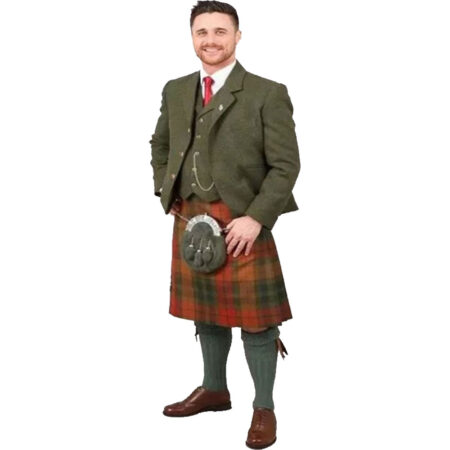
 Maxwell Modern
Clan Maxwell
Maxwell is a Border name and not a Gaelic one. It comes from a place — Maccus’s well, a pool on the River Tweed near Kelso, named for Maccus or Magnus, understood to have been a Norse lord in the reign of David I. The family first appears in the south-west as John de Muccuswell, who acquired the Dumfriesshire lands early in the thirteenth century, and Maxwell power was built on Nithsdale and Annandale rather than on any Highland glen. Around 1220 Alexander II granted Caerlaverock to Sir John Maxwell, who began a first castle there; his brother Sir Aymer abandoned it for the triangular fortress on the neighbouring site, completed in the 1270s, which became the seat of the chief and remained so for close to four centuries. Because the name is territorial and Anglo-Norse in formation, there is no authentic Gaelic form of it, and anything offered as one is a later invention.
Caerlaverock was besieged repeatedly. In July 1300 Edward I brought the English army against it, and sixty men held out for a considerable period before surrendering; the English heralds recorded the event in the Roll of Caerlaverock, a roll of arms in Old French verse. Sir Eustace Maxwell held first for Balliol, then for Bruce, and dismantled his own castle rather than let it be garrisoned against Scotland; Robert Maxwell rebuilt between 1373 and 1410. On 23 October 1448 Herbert, first Lord Maxwell, commanded the Scottish rearguard alongside Lord Adam Johnstone at the Battle of Sark, fought near the Lochmaben Stone at Gretna — a heavy Scottish victory and the last pitched battle between the two kingdoms in the medieval period. The Johnstone alliance did not hold. On 7 December 1593 John Maxwell, 8th Lord Maxwell, who had carried the earldom of Morton since 1581 and the wardenship of the West March, was killed by the Johnstones at Dryfe Sands near Lockerbie; his son was executed in 1613 for the revenge killing that followed. Robert Maxwell, 10th Lord, was created 1st Earl of Nithsdale and built the Nithsdale Lodging inside the castle walls around 1634. In 1640 Covenanters besieged Caerlaverock for thirteen weeks, took it, pulled down the south wall and tower, and it was never reoccupied. William Maxwell, 5th Earl of Nithsdale, came out for the Jacobites in 1715, was taken at Preston that November and sentenced to death on 9 February 1716; on the eve of his execution he walked out of the Tower of London in a maid’s clothes, a rescue arranged by his wife Winifred Herbert with two other Jacobite women. He died in Rome on 2 March 1744 and the earldom was forfeit.
The Maxwell tartan
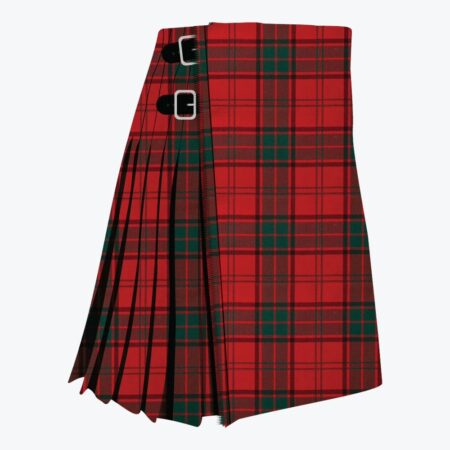
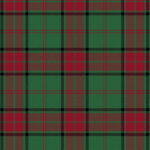
The Scottish Register of Tartans returns three records for Maxwell, and only two of them are clan setts. The principal pattern, listed under Clan/Family, is credited to the Sobieski Stewarts. A second, Maxwell Hunting, is recorded with no designer and no date given. The third is a modern personal tartan designed by Kinloch Anderson and recorded on 5 May 2016. Nothing under the name is attributed to Wilsons of Bannockburn, the Stirlingshire firm whose pattern books supplied the trade from the late eighteenth century onwards.
The Sobieski Stewart attribution places the Maxwell sett squarely in the Vestiarium Scoticum, published in Edinburgh by William Tait in 1842. Its authors, John and Charles, styled themselves grandsons of Prince Charles Edward Stuart and presented the book as a reproduction of a fifteenth-century manuscript of clan tartans. It ran to roughly seventy-five coloured plates and was divided into Highland clans followed by Lowland Houses and Border Clans — that second section is where families like the Maxwells acquired a tartan they had never previously had.
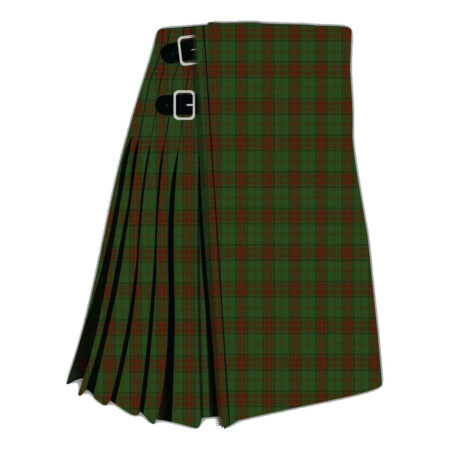
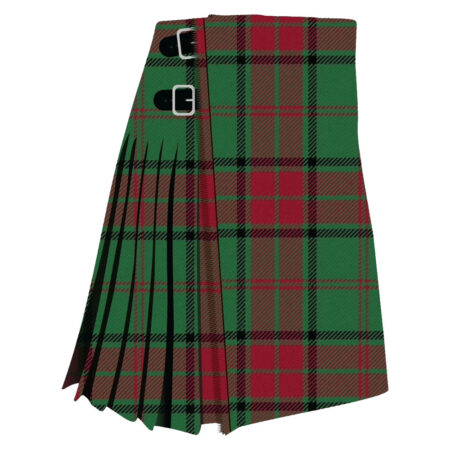
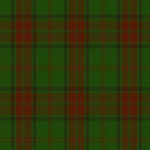
A note on honesty: the Maxwell tartan was made up. The Vestiarium was denounced as a forgery almost at once. Walter Scott had already written sceptically in 1829, pointing among other things to the false Latin of the title; the Douay manuscript of 1571 that the brothers claimed as their source was never produced for anyone else to examine; and chemical testing by Stevenson Macadam later showed that their 1721 transcript had been treated to make the writing look older than it was. None of this stopped the designs passing into use as official clan tartans, and the Maxwell sett is one of them. Maxwell Ancient, Modern and Weathered are not separate tartans either — they are the same threadcount woven in different dye shades, and the Register holds no separate record for any of them.
Clan facts
| Chief | None. Clan Maxwell is armigerous, with no chief recognised by the Court of the Lord Lyon, and does not appear among the members of the Standing Council of Scottish Chiefs. The Maxwells of Munches are the heir-male representatives of the Earls of Nithsdale; John Maxwell of Terraughty and Munches was served heir-male to the 4th Earl on 4 June 1778 |
|---|---|
| Motto | Reviresco — “I grow strong again”, also rendered “I flourish again” |
| Plant badge | Holly |
| Lands | Nithsdale and Annandale in Dumfriesshire; the chief’s seat at Caerlaverock Castle until 1640 |
References
Versions of the Maxwell tartan
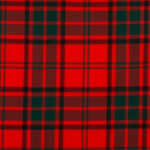
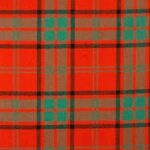
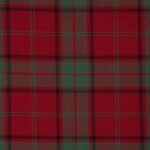
Maxwell kilts & outfits
Every piece below is made to measure by Kilt 4 Less in the Maxwell tartan. Choose a product, then pick your size and options.
Clan Maxwell Hunting Modern Tartan Kilt
Original price was: £241.80.£159.00Current price is: £159.00.View kiltMen’s 8 Yard Prince Charlie Kilt Outfit
Original price was: £499.00.£315.00Current price is: £315.00.ConfigureMcCalls Highland Kilt Outfit With Argyll Jacket
Original price was: £510.00.£325.00Current price is: £325.00.ConfigureScottish Wedding Men Kilt Outfit
Original price was: £700.00.£304.00Current price is: £304.00.ConfigureForest Green Tweed Jacket Kilt Outfit
Original price was: £489.00.£249.99Current price is: £249.99.Configure