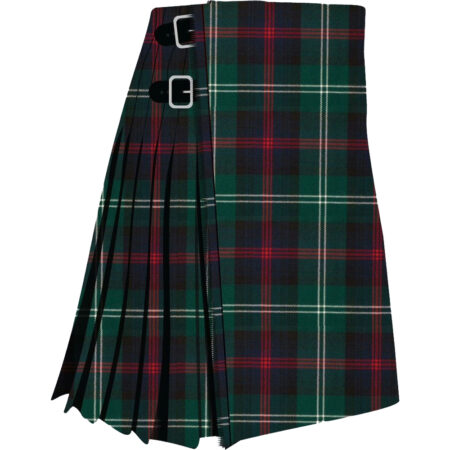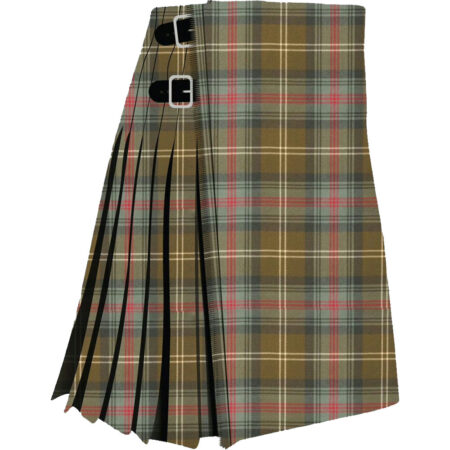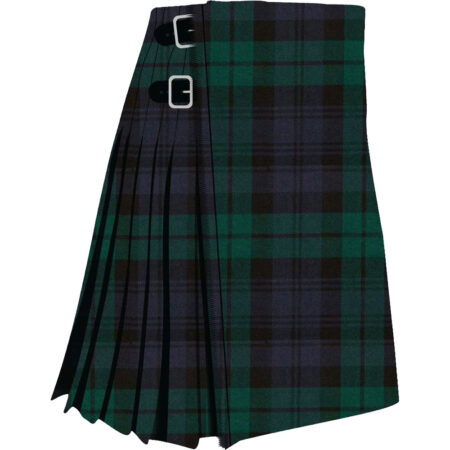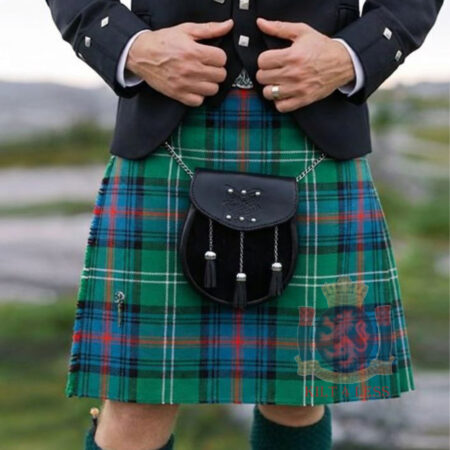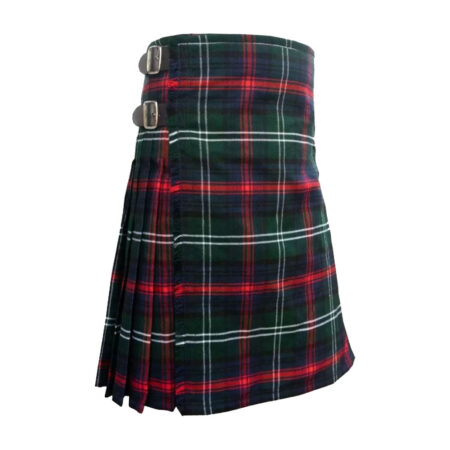
 Sutherland Hunting Modern
Clan Sutherland
Clan Sutherland takes its name from the district, and the district’s name is Norse: Suðrland, the southern land, so called from the standpoint of Orkney and Caithness. In Gaelic the eastern part of the country is Cataibh, among the Cats, and the chief is styled Morair Chat; the clan name itself appears in Gaelic as Suithearlarach. The founding family was not Gaelic either. The progenitor was Freskin, a Fleming in the service of David I, whose descendants were designated de Moravia, of Moray. His grandson Hugh held lands in Sutherland and was styled Lord de Sudrland, and the earldom was created about 1230 for William de Moravia; it is the premier earldom in the Peerage of Scotland. Dunrobin Castle is first authentically recorded in 1401. The clan fought at Bannockburn in 1314, Halidon Hill in 1333 and Neville’s Cross in 1346, quarrelled internally over the succession between 1517 and 1519, and was beaten by Montrose’s royalists at Auldearn in 1645.
The thing most readers associate with the name is the clearing of the Sutherland estates, and it should be stated plainly. Elizabeth, Countess of Sutherland, inherited the estate as an infant and in 1785 married George Granville Leveson-Gower, who became Marquess of Stafford in 1803 and Duke of Sutherland in 1832, and who inherited the Bridgewater fortune that paid for what followed. Patrick Sellar and William Young arrived in 1809 and replaced the factor Cosmo Falconer in 1811. Clearance ran from about 1807 to 1821. Strathnaver was cleared from Whitsun 1814, some 430 families from Strathnaver and Brora, perhaps two thousand people. On 13 June 1814 Sellar’s party burned the house of William Chisholm at Badinloskin; an elderly bedridden woman inside died six days later, and accounts differ over whether she had been carried out first. Sellar was tried for culpable homicide and arson in 1816 and acquitted, which the estate treated as vindication. Another 425 families went in 1819 and 522 in 1820. The people were resettled on coastal crofts to work at fishing and kelp, and the kelp trade collapsed by 1820. The 93rd (Sutherland Highlanders) had been raised in 1799 by Major-General William Wemyss for the Countess, and stood at Balaclava on 25 October 1854 as the Thin Red Line.
The Sutherland tartan
A search of the Scottish Register of Tartans for Sutherland returns twelve records. The sett recorded simply as Sutherland is attributed to the Sobieski Stewarts, which places it in the Vestiarium Scoticum of 1842. Sutherland #2 and #3 carry no designer. Sutherland 42nd is a pattern the Clan Sutherland Society of North America traces to Wilsons of Bannockburn’s Key Pattern Book of 1819, close to the Black Watch but with the stripes arranged differently. The remainder are modern: Sutherland Dress, a dance sett by Hugh MacPherson, Sutherland of Duffus, Strath Hallidale from House of Edgar, a Dress Royal dance sett from Tartantown, and three personal tartans.
The same society records the Black Watch or Government sett, adopted for the regiment about 1794 and, it suggests, taken up as a family tartan by about 1800, and a dress version of about 1980 in which the white and green are reversed. It also cites a mention of Sutherland tartan from 1618, well before any of the recorded setts.
A note on honesty: the pattern most people buy as Sutherland first appears in print in the Vestiarium Scoticum of 1842, a book that is a known forgery. Its claimed fifteenth-century manuscript was never produced for examination, a supposedly 1721 manuscript was found in 1895 to have been chemically treated to look older, and Walter Scott had asked for expert scrutiny of the brothers’ claims as early as 1829. Sutherland Ancient, Modern, Weathered and Muted are not four tartans; the Register holds no separate record for any of them, because they are one threadcount woven in different dye shades. The older and better-evidenced Sutherland cloth is the Government sett, and that is an eighteenth-century military issue, not a family uniform.
Clan facts
| Chief | Alistair Charles St Clair Sutherland, 25th Earl of Sutherland; succeeded his mother Elizabeth, 24th Countess of Sutherland, on 9 December 2019 |
|---|---|
| Motto | Sans Peur — “Without fear” |
| Plant badge | Cotton sedge; butcher’s broom is also recorded |
| Lands | Sutherland, in the far north; Dunrobin Castle near Golspie the historic seat, the family seat now the House of Tongue |
References
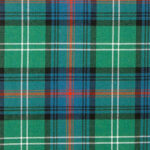
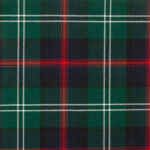
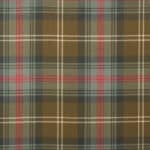
Versions of the Sutherland tartan
Sutherland kilts & outfits
Every piece below is made to measure by Kilt 4 Less in the Sutherland tartan. Choose a product, then pick your size and options.
Sutherland Old Modern Tartan Kilt
Original price was: £210.00.£122.00Current price is: £122.00.View kiltSutherland Old Weathered Tartan Kilt
Original price was: £210.00.£122.00Current price is: £122.00.View kiltSutherland Hunting Modern Tartan Kilt
Original price was: £210.00.£100.00Current price is: £100.00.View kiltSutherland Old Ancient Tartan Kilt
Original price was: £189.00.£79.00Current price is: £79.00.View kiltMen’s 8 Yard Prince Charlie Kilt Outfit
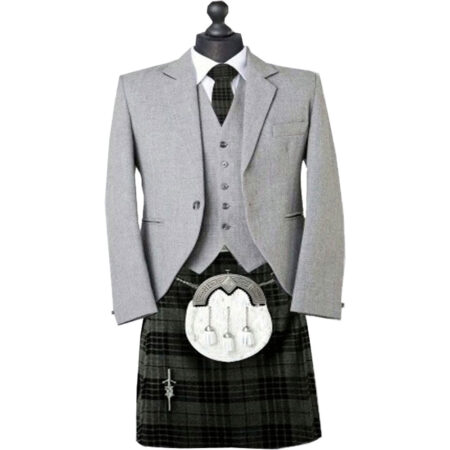
Original price was: £499.00.£315.00Current price is: £315.00.ConfigureMcCalls Highland Kilt Outfit With Argyll Jacket
Original price was: £510.00.£325.00Current price is: £325.00.ConfigureScottish Wedding Men Kilt Outfit
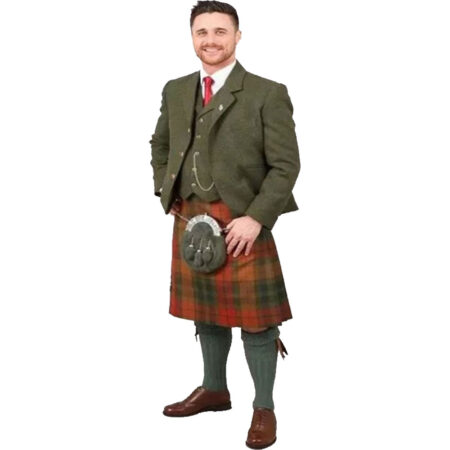
Original price was: £700.00.£304.00Current price is: £304.00.ConfigureForest Green Tweed Jacket Kilt Outfit
Original price was: £489.00.£249.99Current price is: £249.99.Configure