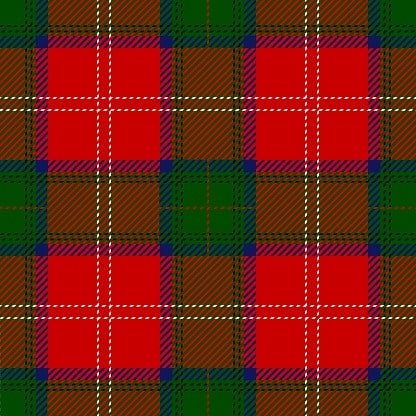
Clan Chisholm
Clan Chisholm, in Gaelic Siosal, is a Highland clan whose country was Strathglass in Inverness-shire, running up from the Beauly river into Glen Affric and Glen Cannich. The name is not Gaelic in origin and the clan is not originally a northern one. The clan historian Alexander Mackenzie derived the surname from the Norman de Chese joined to the Saxon holme, and the family first appears in the Borders, holding land around Roxburgh and Berwickshire in the thirteenth century, with the name on Scottish record by the reign of Alexander III. Clan tradition has the Strathglass lands coming to the family by marriage around 1400. In 1538 James V granted the barony of Comarmore to John Chisholm, and the chiefs moved from Comar House to Erchless Castle, which stayed the seat until it was sold in 1937.
The Jacobite record is real but the sources disagree about its shape. Chisholm of Crocfin led two hundred clansmen at Sheriffmuir in 1715, and Roderick Chisholm, twenty-first chief, forfeited the estate for supporting the Old Pretender; the lands were restored in 1743. For the rising of 1745 the Strathglass account has the chief staying neutral while his youngest son went out, while other accounts have the clan led into the field outright. What is not disputed is that Roderick Og Chisholm took about eighty men to Culloden in April 1746 and that thirty of them were killed, himself among them. The heavier chapter came afterwards and the chiefs wrote it themselves. Alexander, twenty-third chief, refused to remove his tenants; after his death in 1793 his half-brother William and William’s wife Elizabeth MacDonnell, a committed improver, cleared them in numbers between roughly 1801 and 1811, and Alexander, twenty-fifth chief, carried on after William died in 1817. Strathglass emptied towards the American colonies and the glens never refilled.
The Chisholm tartan
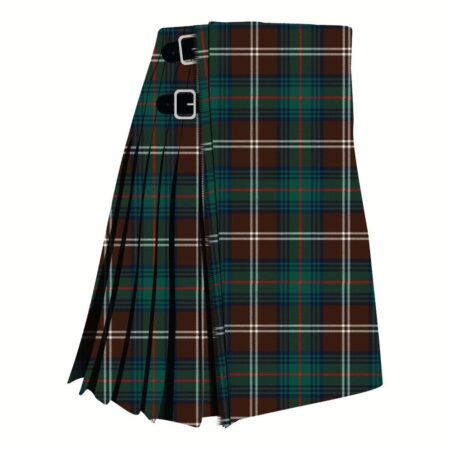
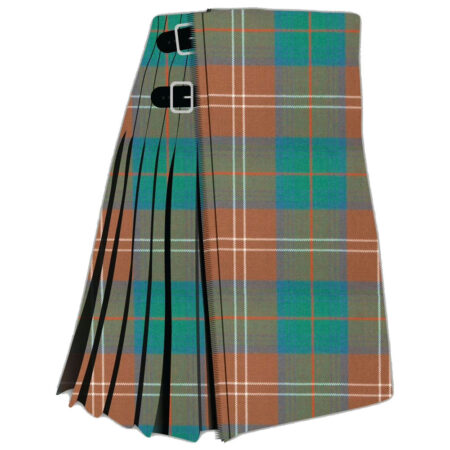
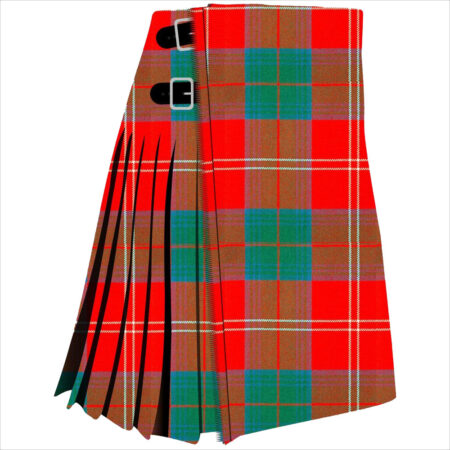
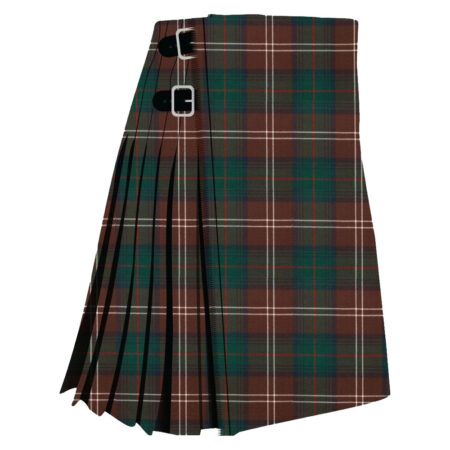
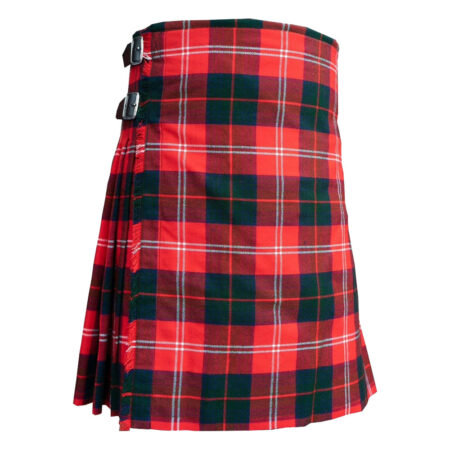
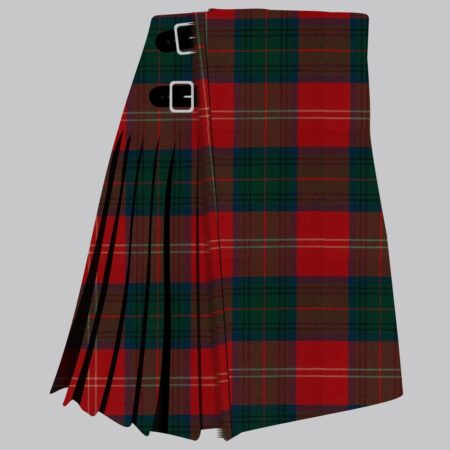
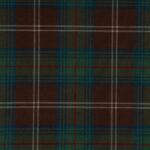
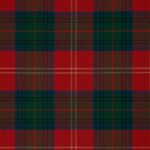
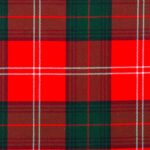
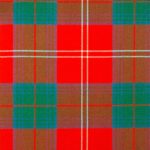
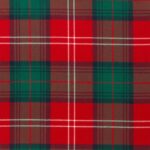
The Scottish Register of Tartans returns five entries for the name. The sett almost everyone means by Chisholm, the red one, is recorded as Chisholm – 1842, and its designer is given as the Sobieski Stewarts. That single line is the whole provenance of the tartan. The remaining entries are Chisholm – 1800, filed under Other with no designer and no date; Chisholm Hunting, also with neither; Chisholm Colonial by Kat Moore, approved in 2008 for Chisholms who emigrated; and a personal tartan for Christopher Chisholm recorded by Brian Wilton on 2 December 2015. No Chisholm sett is credited to Wilsons of Bannockburn, the Stirlingshire firm behind much of the older tartan trade.
A note on honesty: the source of the Chisholm tartan is a forgery. The Sobieski Stuart brothers published the Vestiarium Scoticum in Edinburgh in 1842 through the publisher William Tait, presenting seventy-five colour plates of clan setts as a reproduction of a fifteenth-century manuscript. They claimed descent from Charles Edward Stuart and were denounced as impostors soon after publication; Sir Walter Scott doubted both the men and the book in their own lifetimes; chemical testing in 1895 found the manuscript had been treated to make the writing look aged. The scholarly verdict is settled, and the book is nonetheless the origin of a great many tartans now sold as clan setts, Chisholm among them. So the red Chisholm has a firm date, 1842, and a firmly discredited pedigree, and it is a good deal younger than the clearances that emptied Strathglass.
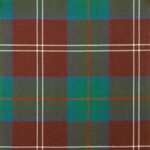
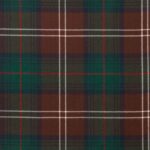
The other thing worth saying plainly is that Chisholm Ancient, Chisholm Modern and Chisholm Weathered are not three tartans. The Register defines a tartan by its threadcount, which it describes as the DNA of a tartan, and it holds no separate record under any of those three names. They are one threadcount woven in lighter, standard or muted dye shades, and a weaver can produce all three from the same instructions.
Clan facts
| Chief | Andrew Francis Hamish Chisholm of Chisholm, thirty-third Chief of Clan Chisholm; listed as a member of the Standing Council of Scottish Chiefs |
|---|---|
| Motto | Feros ferio — “I am fierce with the fierce” |
| Plant badge | Fern |
| Lands | Strathglass, Glen Affric and Glen Cannich, Inverness-shire; barony of Comarmore granted 1538; seat at Erchless Castle until its sale in 1937 |
References
Versions of the Chisholm tartan
Chisholm kilts & outfits
Every piece below is made to measure by Kilt 4 Less in the Chisholm tartan. Choose a product, then pick your size and options.
Chisholm Hunting Modern Tartan Kilt
Original price was: £210.00.£122.00Current price is: £122.00.View kiltChisholm Hunting Ancient Tartan Kilt
Original price was: £241.80.£159.00Current price is: £159.00.View kiltChisholm Red Ancient Tartan Kilt
Original price was: £241.80.£159.00Current price is: £159.00.View kiltChisholm Hunting muted Tartan Kilt
Original price was: £241.80.£159.00Current price is: £159.00.View kiltChisholm Red Modern Tartan Kilt
Original price was: £210.00.£122.00Current price is: £122.00.View kiltChisholm Ancient 1842 Variant Tartan Kilt
Original price was: £241.80.£159.00Current price is: £159.00.View kiltMen’s 8 Yard Prince Charlie Kilt Outfit
Original price was: £499.00.£315.00Current price is: £315.00.ConfigureMcCalls Highland Kilt Outfit With Argyll Jacket
Original price was: £510.00.£325.00Current price is: £325.00.ConfigureScottish Wedding Men Kilt Outfit
Original price was: £700.00.£304.00Current price is: £304.00.ConfigureForest Green Tweed Jacket Kilt Outfit
Original price was: £489.00.£249.99Current price is: £249.99.Configure