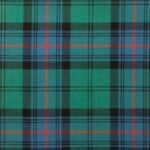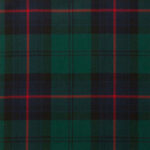
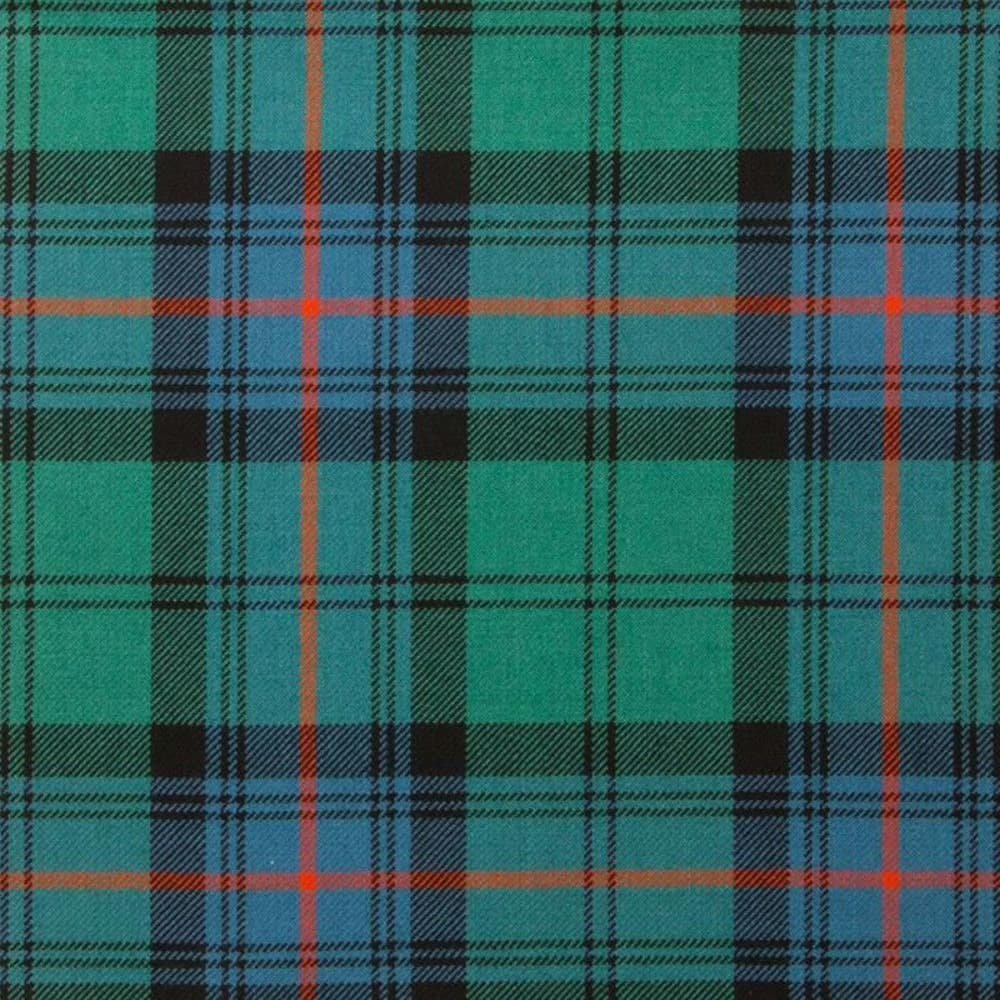
 Armstrong Ancient
Clan Armstrong
The Armstrongs were a riding family of the Borders, holding Liddesdale and the Debatable Lands on the West and Middle Marches, with their principal towers at Mangerton and Gilnockie on the Esk. The surname is recorded in the Borders from the early to middle thirteenth century: the Clan Armstrong Trust gives a first record at Ousby in Cumberland in 1223, while the surname scholar George Fraser Black gives Adam Armstrong, pardoned in 1235 for causing a man’s death. The two dates do not agree. The romantic derivation from a strong-armed retainer who lifted his king back onto a horse, and the descent from Siward Beorn, are folklore.
At their height the Armstrongs were said to be able to put three thousand horsemen in the saddle, which is why the Crown broke them. In July 1530 James V hanged Johnnie Armstrong of Gilnockie and thirty-six of his men at Caerlanrig, despite a safe conduct; the king’s household book places him there on 5 July. The Armstrongs did not come to James’s aid at Solway Moss in 1542. After the Union of the Crowns in 1603 the pacification of the “Middle Shires” finished the job, and in 1610 Archibald Armstrong of Mangerton, the last chief, was hanged in Edinburgh in reprisal for a raid on Penrith. The families scattered, many to Ulster and particularly County Fermanagh.
The Armstrong tartan
There is one registered Armstrong tartan. The Scottish Register of Tartans holds a single entry — Armstrong, reference 115, Clan/Family, dated 1842 — and nothing else under the name: no dress sett, no hunting sett, no Armstrong of Mangerton.
That 1842 date is the whole story. It is the publication year of the Vestiarium Scoticum, and the Vestiarium carries “Armstrang” at plate 68. The book was the work of two brothers who called themselves Sobieski Stuart and claimed descent from Prince Charles Edward; Sir Walter Scott doubted them in 1829, the Quarterly Review demolished the book in 1847, and in 1895 the chemist Stevenson Macadam examined the supposed 1721 manuscript and found it had been treated with chemicals to make the writing look old. The original was never produced.
A note on honesty: Armstrong Ancient, Modern, Weathered and Muted are the same 1842 threadcount rewoven in different dye palettes — colourways, not tartans. There is one Armstrong sett and it dates from 1842, two hundred and thirty-two years after the last chief was hanged; no Armstrong tartan was worn in Liddesdale in the riding days. The often-repeated claim that Neil Armstrong carried Armstrong tartan to the Moon on Apollo 11 is unconfirmed — the Scottish Tartans Museum states that no authoritative source supports it. The museum does document Alan Bean carrying MacBean tartan on Apollo 12 in 1969.
Clan facts
| Chief | None. No Armstrong chief has been recognised by the Lord Lyon since Archibald Armstrong of Mangerton was hanged in 1610. The Clan Armstrong Trust, founded in 1978, is a clan association and confers no chiefly status |
|---|---|
| Motto | Invictus maneo — “I remain unvanquished” |
| Plant badge | Not recorded. Bog myrtle and gromwell are circulated by retailers without any source we could find |
| Lands | Liddesdale and the Debatable Lands; historic towers at Mangerton and Gilnockie, Eskdale. There is no current clan seat. |