
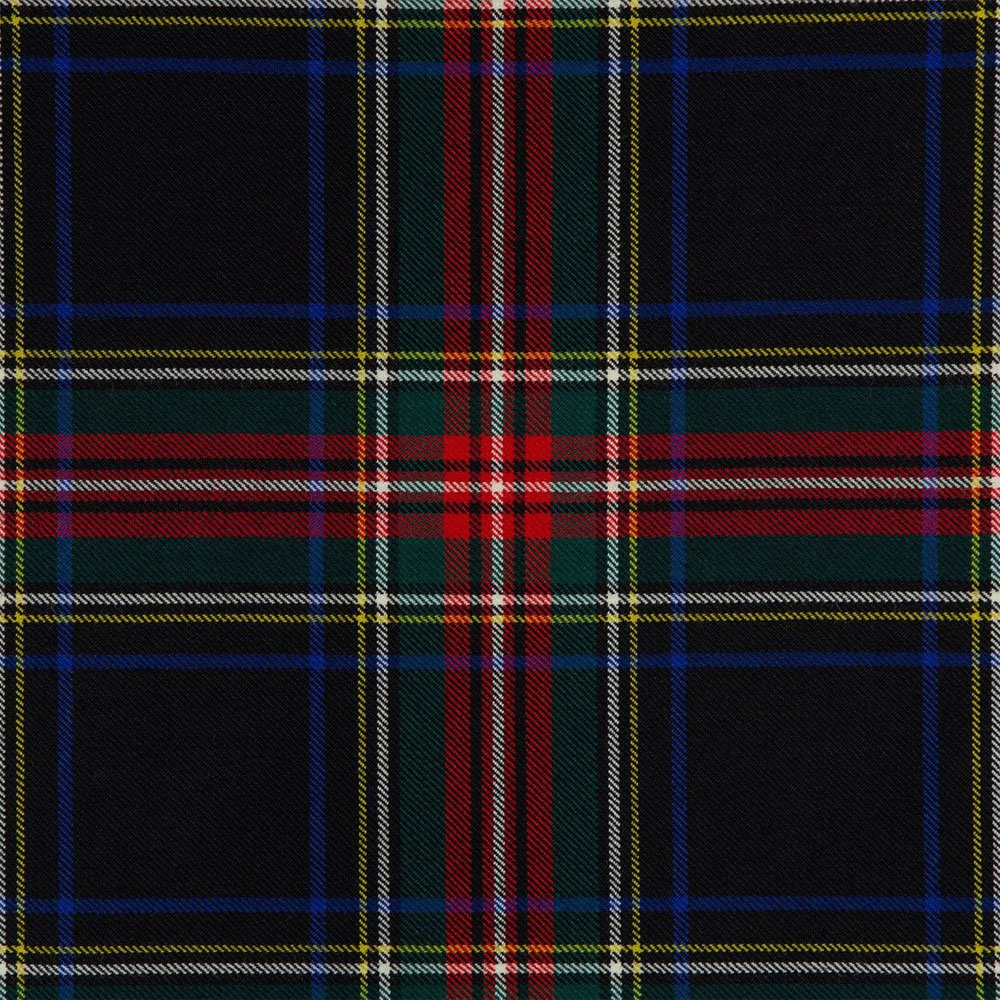
 Black Stewart
Its earliest known samples sit in a spinning firm’s pattern collection rather than in any clan chest, and that tells you most of what there is to know about how it came about.
The Paton’s of Alloa samples
The Stewart Society records this sett in the collection of Paton’s of Alloa, the Clackmannanshire spinners. The collection was for a time in the keeping of the Scottish Tartan Society before being returned to the company. The samples themselves carry no dates, but the collection as a whole is understood to have been assembled around the 1830s, with further pieces added during the Victorian period. That is a useful but limited provenance: it places the pattern in commercial production in the first half of the nineteenth century and says nothing whatever about Stewarts wearing it earlier.
A re-grounded royal sett
In the form normally woven, the design is the Royal Stewart arrangement with the red ground exchanged for black; the proportions and the overchecks belong to the royal pattern. Its history is therefore largely that pattern’s history. The Royal Stewart was first published by James Logan in The Scottish Gaël in 1831, though references suggest the sett was already known at the end of the eighteenth century, and its earliest samples show the blue as a light azure rather than the deep navy now standard.
Recolouring it was a nineteenth-century habit, not a one-off. Monochrome versions of the Royal Stewart appear in Clan Originaux, published at Paris in 1880 by J. Claude Frères et Cie and surviving in a single known copy, and again in the W. & A. K. Johnston collection of 1906; these are sometimes described as mourning tartans. A white-ground version, the Victoria or Dress Stewart, was taken from cloth then in use by James Grant for Tartans of the Clans of Scotland in 1886. The black-ground version belongs with these, as one of a family of alternative grounds worked on a single famous sett.
What that means for wearing it
Nothing here is restricted. The Royal Stewart may be worn by anyone, and a version of it with the ground changed cannot carry a narrower rule than the original; no chief has ever laid claim to the black. Nor is it a branch tartan: it says nothing about descent from any particular Stewart house, and reading it as an Appin, Atholl or Bute pattern would be a mistake. In practice it is chosen for evening wear and for occasions where a red kilt would dominate, which is close to the purpose the mourning and dress variants were serving when they were first woven. It is not a hunting sett, and the darkness is a matter of ground colour rather than of any traditional use in the field.
References
The Stewart Society, Royal Stewart tartan pages, including Stewart Black, the black and white versions and the Victoria sett; Wikipedia, Royal Stewart tartan; Peter Eslea MacDonald, Old & Rare Scottish Tartans by D. W. Stewart: an examination (2022), scottishtartans.co.uk; Scottish Register of Tartans.