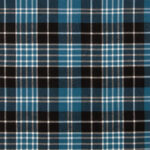
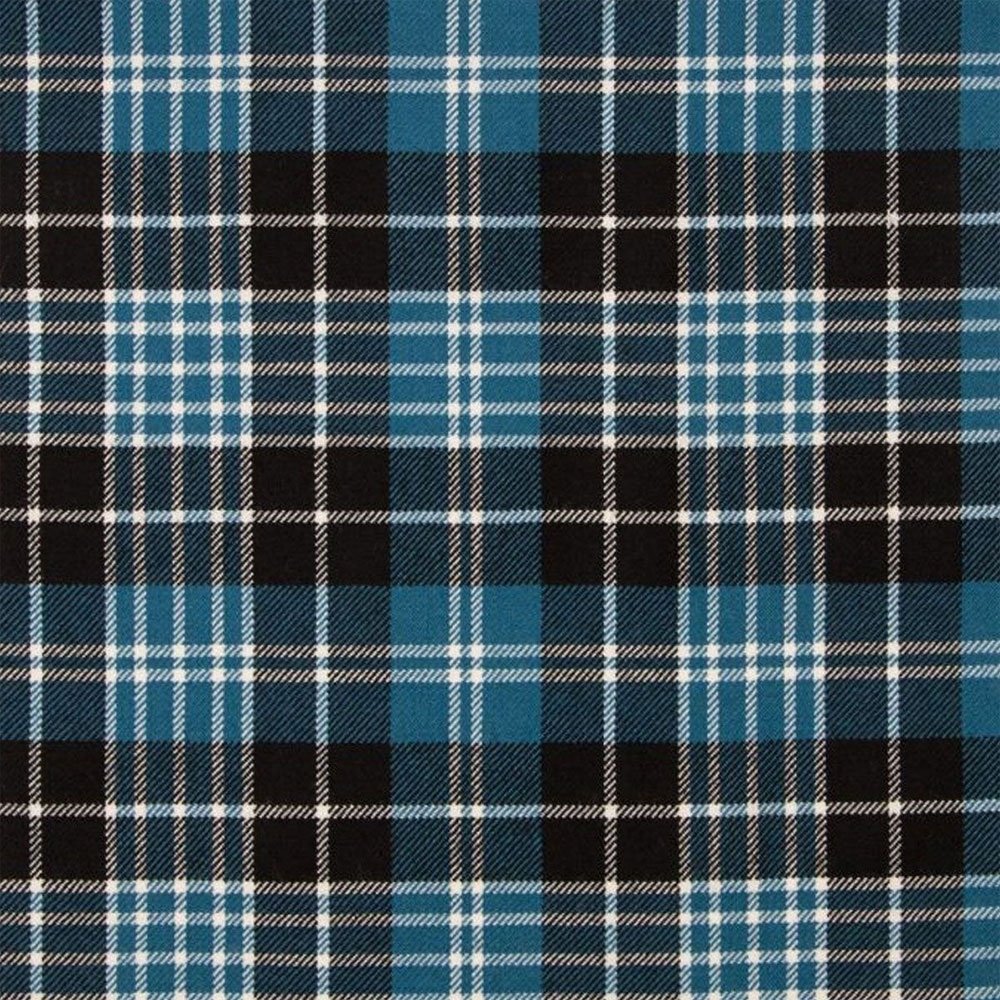
 Clark Ancient
The pattern most often sold today under the Clark name began life not as a family sett at all but as the old Clergy or Priest pattern, with one stripe changed from black to blue.
A surname that means a clerk
Clark is an occupational name rather than a territorial one. It comes from the medieval word for a cleric or a literate man, and it arose independently wherever such men were recorded, in Scotland as in England. The Gaelic equivalent is the group of names built on clèireach, a cleric, which the sept lists of the Highland clans render as MacCleary, MacLerie, MacClair and Clerk, and which was commonly shortened to Clark in English records. That is why the name is scattered so widely: there was never one Clark kindred holding one glen, but many unrelated households whose ancestor had held church office or could write.
Three clans claim it
Clan Cameron lists Clark, Clarke, Clarkson and Clerk among its associated names, alongside the Gaelic cleric names just mentioned. Clan Macpherson lists Clark, Clarke, Clarkson and Clerk as well, which is consistent with the Macpherson descent from Muireach, said to have been the priest of Kingussie in Badenoch. Clan Gregor lists Clark among the alias surnames taken up after the proscription of the MacGregor name in 1603, but places it in the category supported by tradition rather than by documents. None of these three claims excludes the others, and none of them makes Clark a clan. There is no chief of the name of Clark and no ancient sett belonging to it.
The Clergy sett under another name
The pattern trade tells a clearer story than the genealogy. Wilsons of Bannockburn wove a sett they called Priest, dated to about 1830 in the Scottish Tartans Authority records; James Logan published a blue version which he called Clergy. In a letter of October 1971, the tartan historian D. C. Stewart told the collector Andrew Pearson that the Clark tartan asked after was most likely the Wilsons pattern sold as Priest. The relationship survives in what is woven now: Lochcarron sell Clark and Clergy as the same threading, the difference being the colour of the first pivot stripe and the choice of light grey or white. In the Highlands the sett was known as breacan nan clèireach, the tartan of the clergy, which fits the surname exactly.
Clark of Ulva
One genuinely distinct Clark pattern exists. It appears as Clerke of Ulva in Wilsons pattern book number four of 1847, the island of Ulva off Mull having been in Clark hands. In February 2005 the Scottish Tartans Authority was asked to identify a kilt made around 1930 for Francis William Clark and found it to be a well-worn Clerke of Ulva, with the black faded towards brown, the azure gone to a light grey, and orange rather than crimson lines over the blue. The family kept no record of the name ever being spelled Clerke. Later weavings that substitute a true red for the orange are held by the Authority to be wrong.
Who it sits with
Without a chief there is nobody to grant or withhold permission. In practice Clarks wear the Clergy-derived sett, or Cameron or Macpherson if they can trace a line into either clan, or Clark of Ulva if the island connection means something to them. Any of those is defensible; none can be called the tartan of the name.
References
Scottish Tartans Authority, tartan ferret records for Clark, Clergy, Priest and Clark of Ulva; Clan Cameron and Clan Macpherson associated-name lists, Wikipedia; Clan Gregor alias surnames, Wikipedia; Peter Eslea MacDonald, The Development of Clan Tartans, scottishtartans.co.uk.