Clan Balfour
Balfour is a Fife territorial name, taken from the lands of Balfour in the parish of Markinch, where the River Ore meets the Leven. Several origin stories attach to the family — descent from a Siward who came north from Northumbria, a grant of Strathor and the Isle of May by King Edgar in 1097, lands held in the reign of Duncan I — and all of them are tradition rather than record. The documentary picture is thinner and less tidy. A charter from William the Lion to Sir Michael de Balfour is dated to about 1196 in antiquarian accounts; a John de Balfure sat on an assize in 1304, and is elsewhere called the first of the name on record, which contradicts the earlier date. We have not been able to settle which is the earliest secure record. The original lands did not stay with the family: the heiress Janet Balfour married Sir Robert de Bethune, and the Bethunes held Balfour from about 1375 until it was sold in 1888. The house has since been demolished.
Branches took Denmylne, granted to James Balfour in 1451, as well as Kinloch, Forret and Torry. James Balfour was killed at the siege of Roxburgh in 1460 and John Balfour at Flodden in 1513. The Kinross line is the best documented: Sir John Balfour acquired the lands of Burleigh about 1445, a tower house followed about 1500, and a corner tower was added in 1582 by Sir James Balfour of Pittendreich and Margaret Balfour, heiress of Burleigh. James VI stayed there several times between 1587 and 1596. The Lordship of Balfour of Burleigh was created for Sir Michael Balfour on 16 July 1607, and Robert Balfour was tried for murder in 1707. The 5th Lord was attainted for the Jacobite rising of 1715, with the lands lost the following year, and the attainder was reversed on 19 March 1869 in favour of the Bruce family — so the title is no longer held by anyone of the Balfour surname.
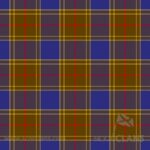
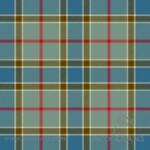
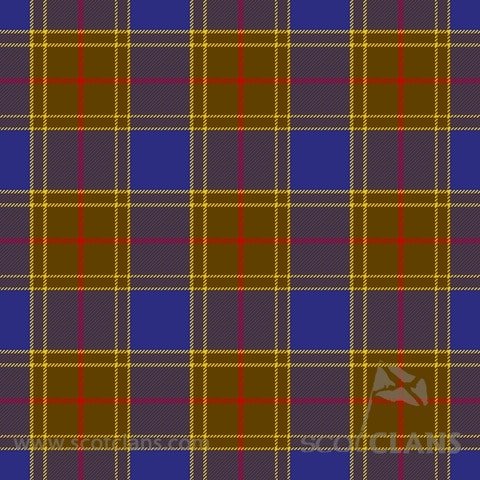
The Balfour tartan
Every recorded Balfour sett belongs to the 1980s or later, and the register names no weaver or historic source for any of them. Balfour, registered with a date of 1 January 1984, was proposed by William Robert Balfour as a name tartan. Balfour #2, also of 1984 and recorded by the Scottish Tartans World Register as Balfour Blue and Brown, is a genuinely distinct sett, designed at the suggestion of Balfour Rombach and based on the Gordon of Abergeldie tartan. Balfour Hunting is registered separately but has the same stripe counts as the first sett with the black band replaced by green. We could not open the register’s own detail pages to confirm reference numbers first-hand, so none is printed here.
A note on honesty: Balfour Hunting is a colour variant of the 1984 Balfour sett rather than a new design, and the several tartandictionary entries under Balfour (Clan) and Balfour Blue and Brown are recordings or colourways of the #2 sett, not further tartans — which leaves two genuinely distinct Balfour designs, both from 1984. No Balfour sett predates the commercial era. None of the sources we checked gives any Balfour tartan a Wilsons of Bannockburn origin or a place in the Vestiarium Scoticum, and we found no evidence that Balfours customarily wore another clan’s tartan before these setts were designed.
Clan facts
| Chief | None. Balfour is an armigerous clan with no chief recognised by the Lord Lyon, and no commander has been appointed |
|---|---|
| Motto | “Fordward” — Scots for “forward”. The Lords Balfour of Burleigh, a separate line, use Omne solum forti patria — “every country is a brave man’s homeland” |
| Plant badge | Not recorded |
| Lands | Balfour in Markinch, Fife, the original lands, lost to the Bethunes; Burleigh Castle, Kinross; Denmylne, Kinloch, Forret and Torry. Sources differ over which should be called the seat |