
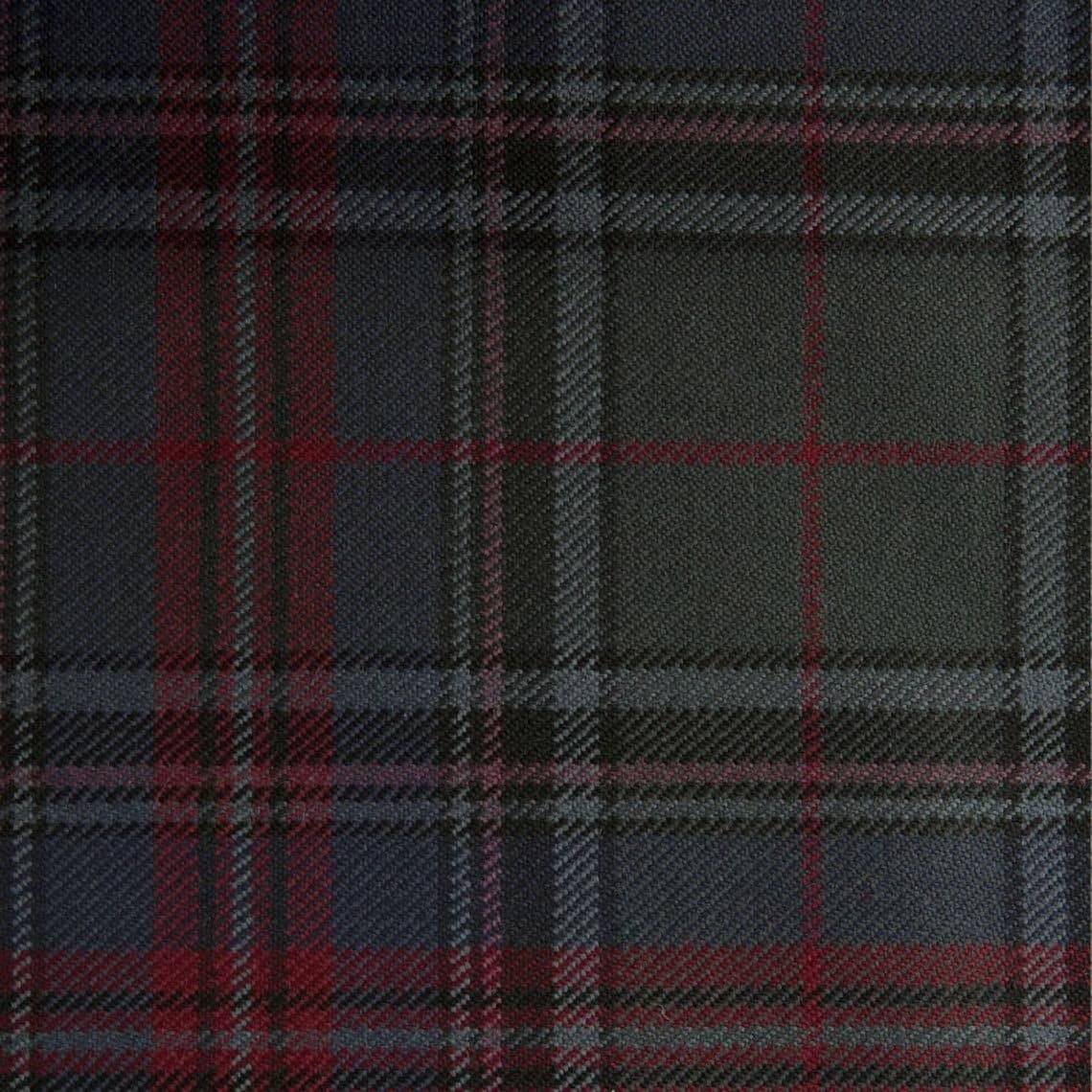
 Grey Stewart
The honest position on this one is that it is a change of ground colour with a name attached, and no dated first appearance has been traced for it.
The sett underneath
What is being worn here is the Royal Stewart. The sequence of stripes, the proportions and the fine overchecks are that pattern; the change is that the broad red ground has been replaced by grey. So the design history belongs to the royal sett, which James Logan first published in The Scottish Gaël in 1831, and which references indicate was already known before the close of the eighteenth century. Early samples of it show the blue as a light azure rather than the deep navy that became standard later.
Why the Royal Stewart has so many grounds
Reworking that one sett on other grounds was routine in the nineteenth century, and the grey belongs to that practice rather than to a separate tradition. Monochrome versions are recorded in Clan Originaux, printed at Paris in 1880 by J. Claude Frères et Cie and now known in a single copy, and in the W. & A. K. Johnston collection of 1906; these are sometimes called mourning setts. A black-ground version appears in the Paton’s of Alloa sample collection, put together around the 1830s with Victorian additions. A white-ground one, the Victoria or Dress Stewart, was copied from cloth then in wear by James Grant for Tartans of the Clans of Scotland in 1886.
For the grey specifically, the documentary record is thin, and it is worth saying so plainly rather than inventing a lineage. No collector or pattern book consulted here dates a grey-ground Royal Stewart, and the design is best understood as a later member of the same set of variations, produced because the market wanted a quieter version of a very loud tartan. A grey ground also sits close in effect to the weathered and muted dye ranges the mills offer on ordinary red Stewart cloth, which is a further reason the two are often confused.
Wearing it
No permission is involved. The Royal Stewart may be worn by anyone, and a version of it with a different ground cannot be more restricted than the sett it is taken from; no chief has adopted the grey or spoken for it. It makes no statement about descent from any Stewart branch, and it should not be read as an Appin, Atholl or Bute pattern. Its use is straightforwardly practical: the royal sett in a register that will go with grey and charcoal without competing, and that suits evening wear and formal daytime dress better than the red does.
Sources: The Stewart Society, Royal Stewart tartan pages, including the black and white versions, Stewart Black and the Victoria sett; Wikipedia, Royal Stewart tartan; Scottish Register of Tartans; Peter Eslea MacDonald, Old & Rare Scottish Tartans by D. W. Stewart: an examination (2022), scottishtartans.co.uk.