 Borthwick Ancient
Clan Borthwick
Borthwick is a territorial name from the lands of Borthwick in Midlothian. The earliest date we can actually document is about 1410, when Sir William Borthwick obtained a charter confirming those lands, with further holdings in Midlothian and the Scottish Borders. The traditional descent from a Livonian knight called Andreas, said to have come to Scotland with Edgar the Ætheling and St Margaret in 1067, is exactly that — tradition, and presented as such even by the sources that repeat it.
The firmest date in the whole Borthwick record is 2 June 1430, when Sir William, later 1st Lord Borthwick, obtained a licence from James I to erect a castle on the Mote of Locherwart. Borthwick Castle was built that year and stands about twelve miles south-east of Edinburgh; it remains in the family’s ownership. Mary, Queen of Scots visited in August 1563 and October 1566, and in June 1567 she and the Earl of Bothwell were besieged there. Cromwell’s forces attacked in 1650 and the garrison surrendered after a few cannon shots.
The Lordship of Borthwick was created in the mid-fifteenth century — Burke’s gives 12 June 1452, while Nisbet puts it earlier in the reign of James II, and the two conflict. It then went dormant three separate times: on the failure of the male line in 1675, for eighty-seven years until Henry Borthwick’s claim was admitted by the House of Lords in 1762; again on his death in 1772, with unsuccessful claims in 1808 and 1816 before Cunninghame Borthwick was allowed the title in 1870; and again from 1910 until the Lord Lyon admitted the claim of John Henry Stuart Borthwick in 1986, making him 23rd Lord. John Hugh Borthwick, 24th Lord Borthwick, died in 2025 and the lordship passed to his twin brother, James Henry Alexander Borthwick, 25th Lord Borthwick; several clan directories still list the 24th Lord. We have found no source confirming that the Lord Lyon has yet recognised the 25th Lord specifically as chief, which is a separate act from holding the peerage, so we do not claim it.
The Borthwick tartan
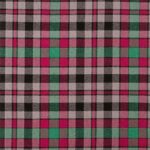
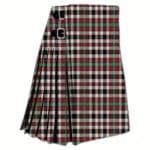
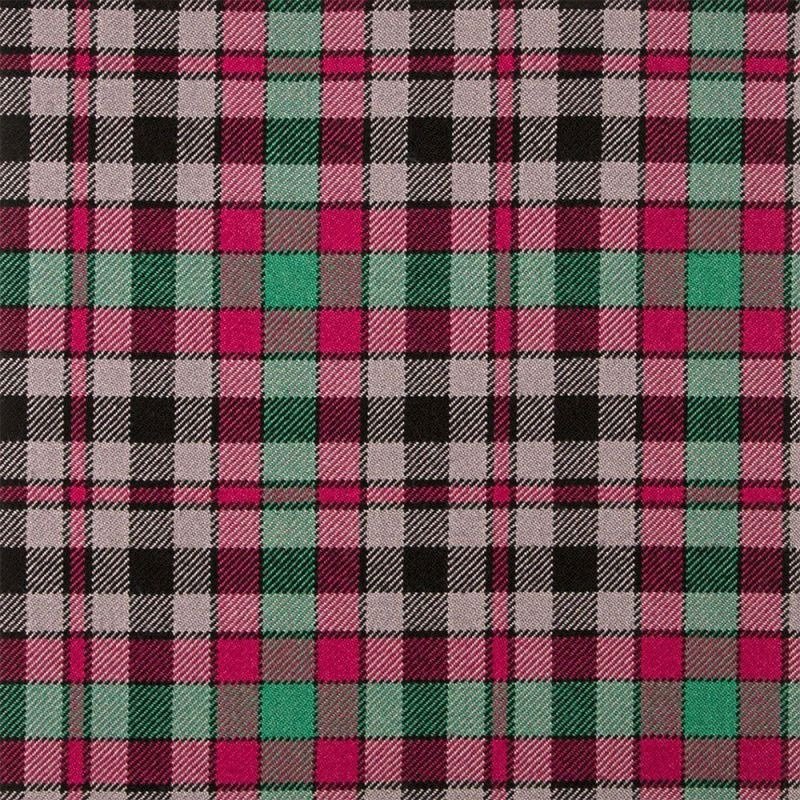
The principal Borthwick sett — green and red with a navy stripe between black guards — carries a recorded date of 1951, and the same threadcount is also recorded under the name Borthwick Hunting. That is an alternative name for one sett, not a second tartan. A second, structurally different pattern with a yellow stripe in place of the navy is recorded with no date, designer or source at all. Larger-count records of the navy sett, including one labelled “Clan”, are rescalings rather than new designs.
Borthwick Dress, dated 1975, is the interesting case: it is a genuinely distinct threadcount rather than a plain colourway. Checked band by band against the main sett, the navy stripe is not merely recoloured white but narrowed from twenty-four threads to fourteen, and the closing red guard is replaced by white. A true colourway keeps every band width and changes only shades, so the dress pattern is correctly sold as its own sett, derived from the Borthwick design rather than identical to it.
A note on honesty: Borthwick Modern, Ancient and Weathered are colourways, not separate tartans. No Borthwick sett predates the commercial era — the main pattern is recorded in 1951 and the dress in 1975, so a castle of 1430 and a tartan of 1951 are five centuries apart. Borthwick does not appear among the seventy-five plates of the Vestiarium Scoticum, the 1842 book by the Sobieski Stuarts that was exposed as a forgery, nor is any Wilsons of Bannockburn attribution recorded. No designer is named in any source we could reach.
Clan facts
| Chief | Lord Borthwick, Borthwick of that Ilk. The chiefship was confirmed by the Lord Lyon in 1986; John Hugh Borthwick, 24th Lord, died in 2025 and the lordship passed to James Henry Alexander Borthwick, 25th Lord. Lyon recognition of the 25th Lord as chief is not something we can confirm |
|---|---|
| Motto | Qui conducit — “he who leads” |
| Plant badge | Not recorded |
| Lands | Borthwick, Midlothian, with holdings in the Scottish Borders; ancestral seat Borthwick Castle, built 1430 |