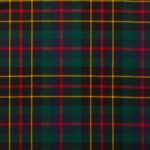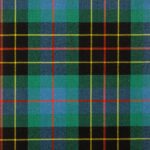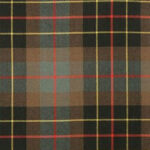
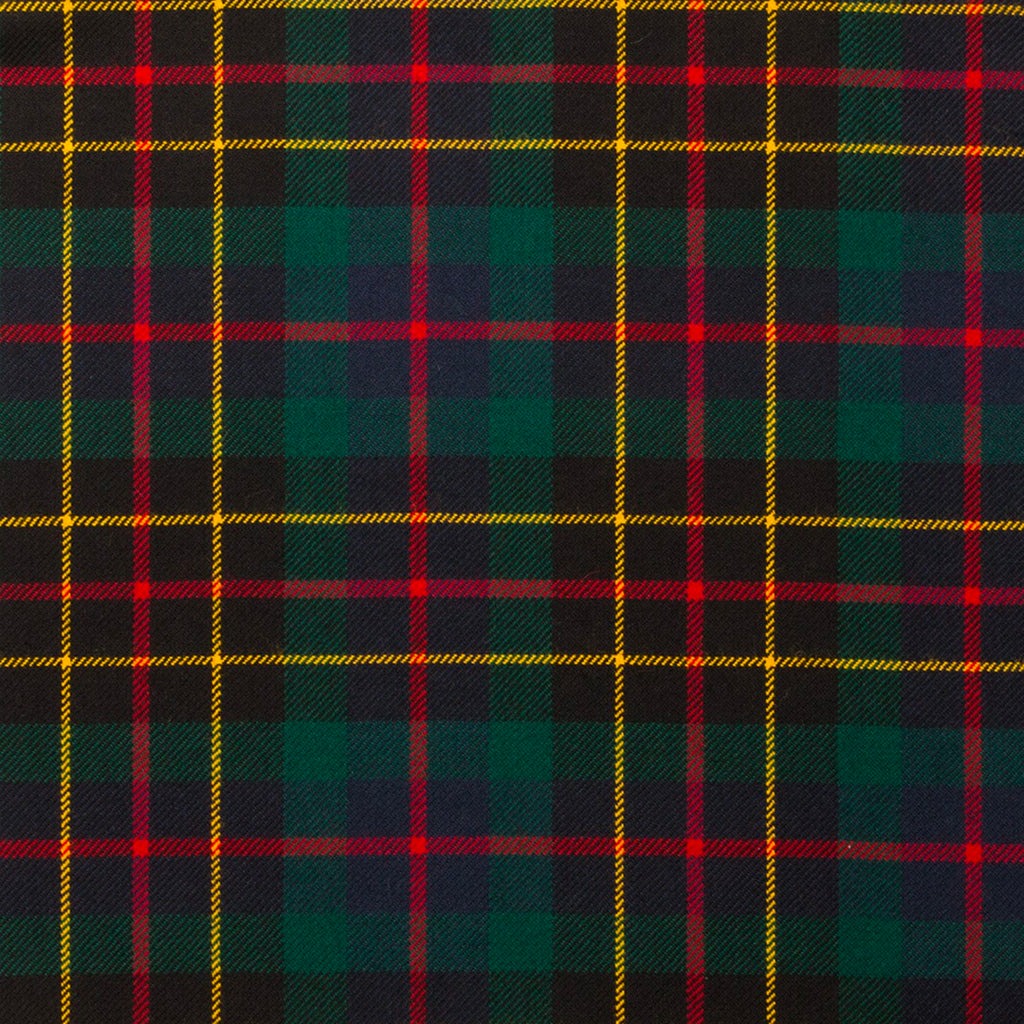
 Brodie Hunting Modern
Clan Brodie
The Brodies were a Moray family seated at Brodie near Forres. Tradition has the lands granted by Malcolm IV around 1160, but no charter survives, and the National Trust for Scotland, which now owns Brodie Castle, words it as tradition too. The earliest secure record is a charter of Robert I of 1311 confirming Michael Brodie in the lands, and designating him Michael, filius Malconi, Thanus de Brothie et Dyke — Michael, son of Malcolm, Thane of Brodie and Dyke. One secondary account dates the Bruce document to 1312 and calls it a letter rather than a charter; we have not seen the original, so this page gives the year and no more.
The date 1567 is carved on the caphouse of the south-west tower of Brodie Castle, which is the earliest positive dating evidence on the building itself. The castle was attacked and burned in 1645 by a Royalist force under Lord Lewis Gordon, later third Marquess of Huntly, during Montrose’s campaign; sources differ over how much of that was Gordon and how much Montrose, and no exact date is recorded. Ninian Brodie, 25th of Brodie, arranged the castle’s transfer to the National Trust for Scotland in the late 1970s, completed by 1980. Both the 25th and the 26th chiefs died in 2003, and the present chief succeeded in that year.
The Brodie tartan
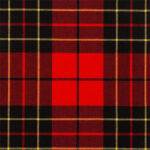
The register returns eight Brodie entries, and they are not all clan tartans. Brodie (Clan) is the familiar red sett. Brodie (W & A Smith) is a second and different Brodie clan pattern, named in the register for its source: the Smith brothers of Mauchline, whose Authenticated Tartans of the Clans and Families of Scotland appeared in 1850. Brodie Hunting is a separate green-ground clan sett, and Brodie Dress is separately registered but is conventionally a white-ground reworking of the red sett rather than an independent pattern. The remaining four are not clan wear: Brodie Silver is a fashion recolouring, Brodie (WCWM) a modern West Coast Woolen Mill design, Brodie Countryfare a corporate tartan for a business, and Brodie, Graeme one man’s personal tartan.
The red sett’s source is almost certainly the Vestiarium Scoticum, which carries a Brodie pattern as plate 59, spelled “Brodye”. The Vestiarium was published in 1842 by the brothers who called themselves the Sobieski Stuarts, and it is a proven forgery: in 1895 the chemist Stevenson Macadam examined the manuscript they claimed was of 1721, found it had been treated with chemical agents, and concluded that it could not be depended on as an ancient document. We could not compare threadcounts to prove the Brodie sett is that plate, because the register’s detail pages do not load. No Brodie sett is attributed to Wilsons of Bannockburn.
A note on honesty: the earliest a Brodie sett can be documented is 1842, and the second pattern 1850, so no Brodie sett predates the commercial era — the 1311 charter dates the lands, not the cloth. “Brodie Red Ancient”, “Brodie Modern”, “Brodie Weathered” and “Brodie Muted” are not registered as separate tartans; they are dye colourways of the one red threadcount, and the same is true of the Ancient and Modern renderings of Brodie Hunting. Retailers also circulate a Gaelic form of the name; we could not source one, and so record none.
Clan facts
| Chief | Alexander Brodie of Brodie — Alexander Tristan Duff Brodie of Brodie, 27th of Brodie, a member of the Standing Council of Scottish Chiefs |
|---|---|
| Motto | Unite — recorded in English, and needing no translation |
| Plant badge | Periwinkle |
| Lands | Moray; Brodie Castle near Forres, now owned by the National Trust for Scotland, with no Brodie now resident |