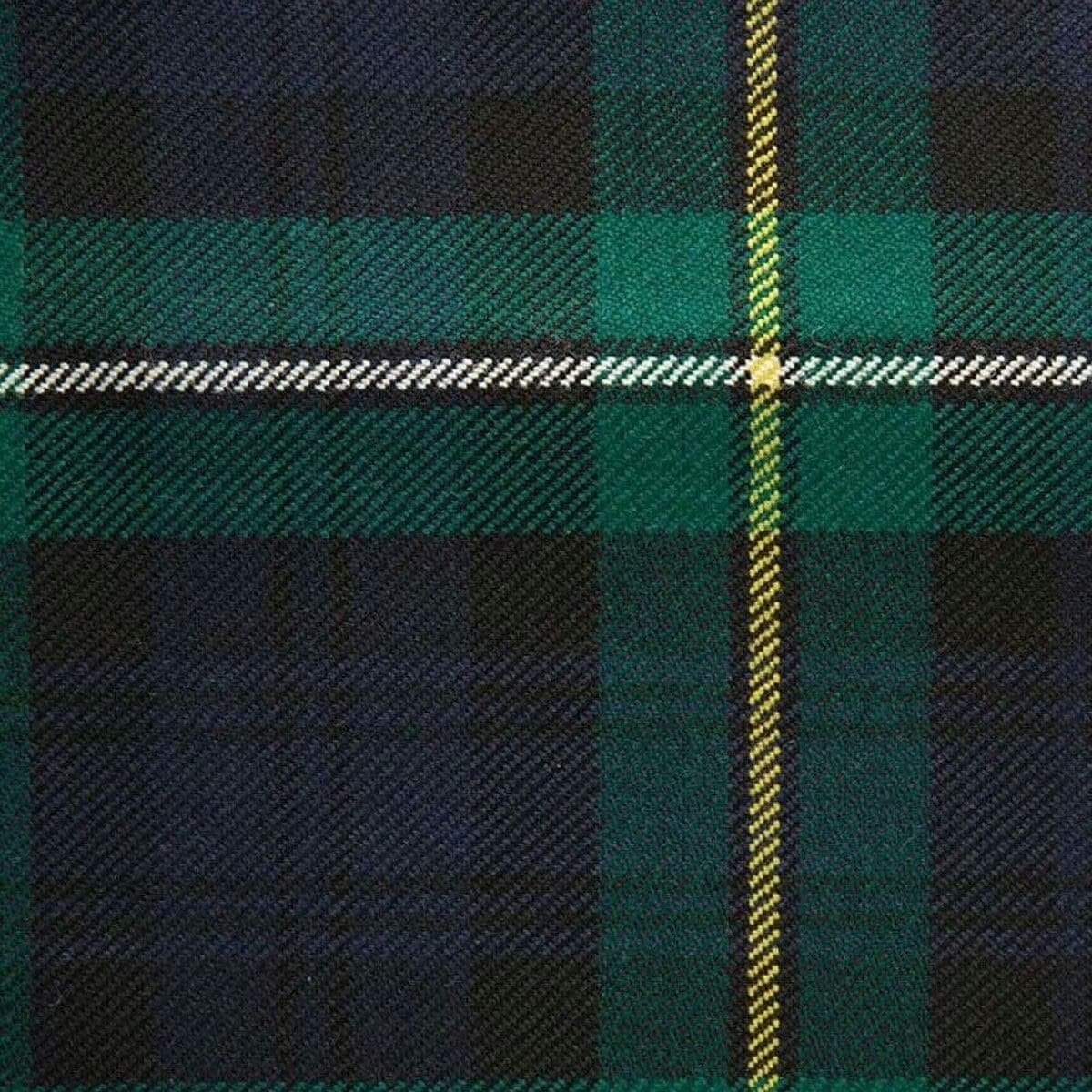
 Campbell Of Argyll Modern
This is the one Campbell sett sold under a chiefly title whose holders have spent seven generations saying that no such tartan exists.
A white line and a duke thought pompous
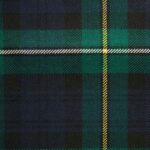
The clan’s own account of the pattern is unusually blunt, and it comes from the top. Alastair Campbell of Airds recorded that the 6th Duke of Argyll added a white stripe to the plain Campbell sett in order to mark himself out from the rest of the name. As chief he was entitled to do it. Nobody else in the family followed him, and the general family view was that the gesture was rather grand for the occasion. The present chief has stated flatly that there is no Campbell of Argyll tartan, and the Clan Campbell Society records that seven successive chiefs have disowned it, some of them with feeling. It is nonetheless still woven, still sold, and still the first thing many people look for when they go searching for a Campbell sett.
What the pattern books show
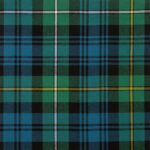
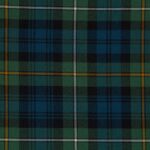
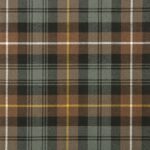
The sett is recorded in the Cockburn Collection, assembled around 1810 to 1815, and it is asymmetric: a dark ground of blue and black with a green block, and a white line at one end of the repeat answered by a yellow line at the other. Older Scottish Tartans Society notes claimed further appearances in Logan of 1831, the Vestiarium Scoticum of 1842, Smibert and Smith of 1850, Grant of 1886 and the W & A K Johnston books of 1906. That list does not survive checking. The Campbell sett printed by William and Andrew Smith is a different pattern altogether, which puts a question mark against the rest of the sequence. What can be said without straining is that a differenced Campbell of this shape was in the Scottish weaving trade by the first decades of the nineteenth century, and that modern weavers work from a version settled in the twentieth.
Differencing that never took in cloth
The 6th Duke was borrowing a habit from heraldry. In Scots armorial practice only the chief bears the undifferenced arms, and every cadet must matriculate a differenced version; the system is administered, recorded and enforceable. Tartan never acquired that grammar. A sett is not matriculated, there is no register of entitlement, and nobody has the power to stop a weaver naming a pattern whatever sells. The duke’s white line therefore had nowhere to go. It marked one man, produced no descendants in cloth, and the only body with an interest in keeping it alive turned out to be the cloth trade itself, which has now done so for well over a century against the stated wishes of the chiefs.
The title behind the name
The style is real even if the tartan is disputed. Colin Campbell was created Earl of Argyll in 1457 and received Knapdale with the title; he moved the chiefly household from the island castle of Innis Chonnel on Loch Awe to Inveraray, where his successors remain. The dukedom of Argyll was created in 1701, and the thirteenth duke, Torquhil Campbell, holds it now along with the chiefship of the whole name as MacCailein Mòr. A pattern named for Argyll is therefore named for the head of the clan rather than for a cadet branch, which is precisely why the chiefs have objected to it so persistently: it implies a distinction they do not claim.
Who can wear it
Anyone, and without the faintest legal difficulty. But the honest answer to the more useful question is this: a Campbell who wants the sett their chief actually stands behind should take the plain Campbell, which is also the Government pattern. Airds listed only four approved Campbell tartans in 1985 — Campbell, Cawdor, Breadalbane and Loudoun — and this is not one of them. To put it on is to put on a nineteenth-century commercial variation, which is no disgrace; a great many setts people now take for ancient are exactly that. It is only worth knowing which one has been chosen.
References
Clan Campbell Society (North America), Clan Campbell tartan page; Alastair Campbell of Airds, Campbell Tartan (1985), as cited there and in the Scottish Tartans Authority notes; Scottish Tartans Authority tartan database, Campbell of Argyll record and its editorial caveats; Wikipedia, Clan Campbell and Innes Chonnel Castle; Scottish Register of Tartans.