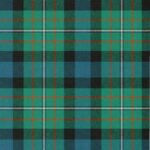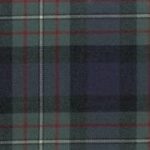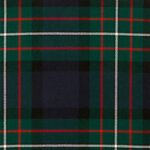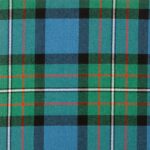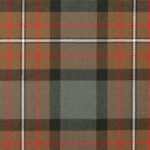
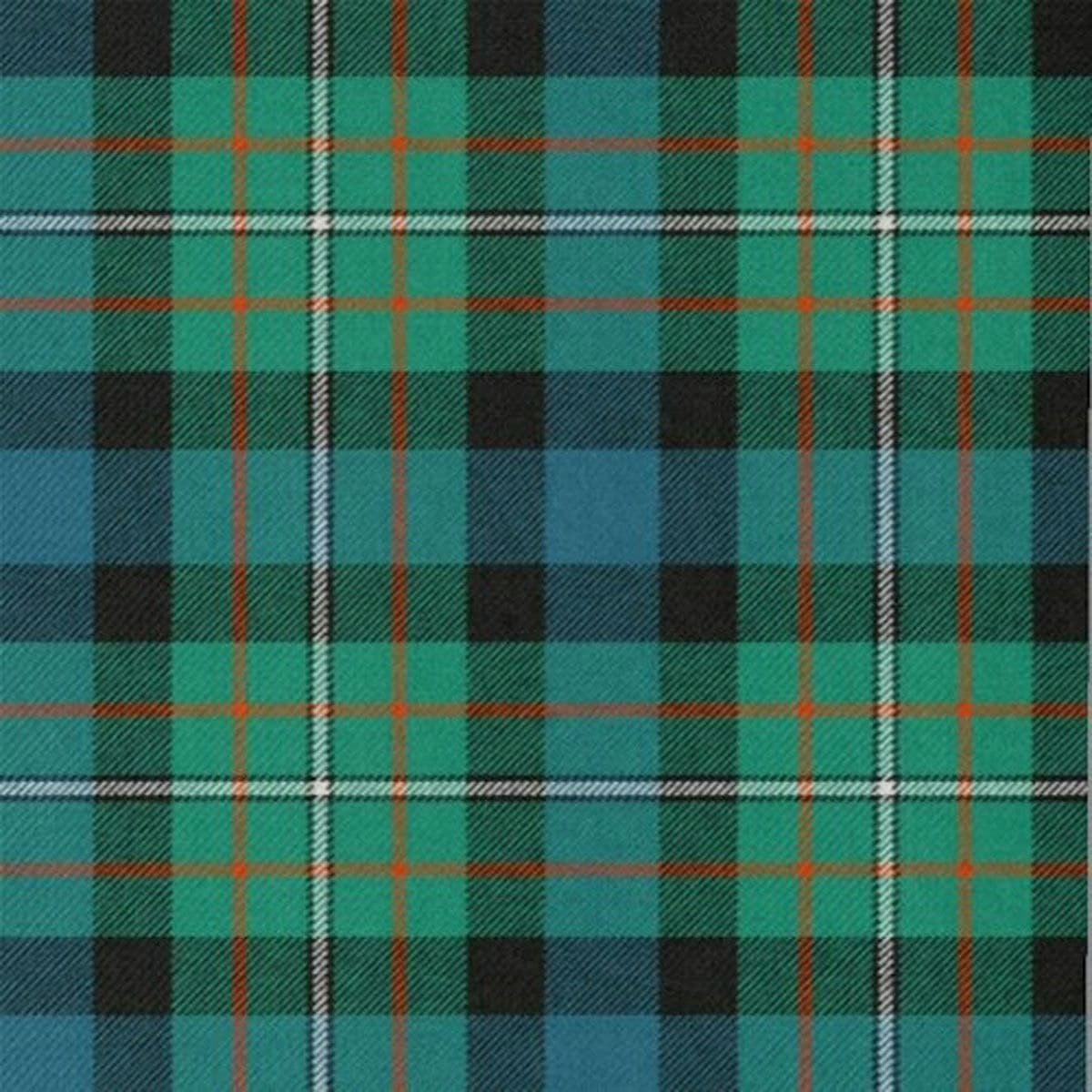
 Ferguson Ancient
Clan Ferguson
The name is a patronymic, in Gaelic MacFhearghuis, son of Fergus, and that simple fact explains most of what follows. Fergus was a common enough personal name that families taking it as a surname arose independently in places that had no connection with each other, and Fergusons are found from Ross-shire in the north to Dumfriesshire in the south. The Argyll branch claims descent from Fergus Mór, the Dál Riata king who came from Ireland, and carries boars’ heads in its arms accordingly; the Ayrshire and Dumfries Fergusons trace themselves instead to Fergus of Galloway, the great lord of David I’s reign who restored the church at Whithorn, founded Dundrennan Abbey and died at Holyrood in 1161. Neither descent can be demonstrated from record. What is on record are the separate houses — Kilkerran in Ayrshire, Atholl and Dunfallandy in Perthshire, Balquhidder, and Craigdarroch in Dumfriesshire — and the spelling divides along the same lines. The chiefly line spells the name Fergusson with a double s; the single-s Ferguson is far commoner among the wider name, and the Register of Tartans files the setts under it.
The Kilkerran Fergussons held their Carrick lands from probably the twelfth century, though the first certain record is John Fergusson of Kilkerran in 1464, and by about 1600 the Fergussons of southern Carrick acknowledged Kilkerran as their chief. A John, son of Fergus, witnessed a charter of Edward Bruce in 1314, the year of Bannockburn. In 1601 Fergussons rode in the band of John Kennedy, 5th Earl of Cassilis, in the skirmish at Maybole in which the Kennedy laird of Bargany was killed — a local feud rather than a national cause, which is characteristic of the family’s history. The Ayrshire Fergussons took the Protestant side at the Reformation, and Sir John Fergusson fought for the king in the civil wars. A later Sir John, an advocate of standing, was created a Baronet of Nova Scotia in 1703, and his son James became a judge of the Court of Session in 1735 with the judicial title Lord Kilkerran. General Sir Charles Fergusson, 7th Baronet, gave close to forty years to the British Army. The baronetcy has carried the chiefship down to the present day.
The Ferguson tartan
The Ferguson setts are better documented than most, and the documentation is commercial. The Scottish Register of Tartans records two patterns credited directly to Wilsons of Bannockburn, the Stirlingshire weaving firm that supplied the bulk of the tartan trade, and dates them in their names: Ferguson – 1819 and Ferguson – 1830. Alongside them the Register holds Ferguson of Balquhidder, credited to James Logan, the Aberdeen antiquary who published The Scottish Gaël in 1831; Ferguson of Atholl, with no designer recorded; and Ferguson Dress, a design of D. C. Dalgliesh of Selkirk. Later entries are modern and personal, including Ferguson (Tarlogie) by Malcolm J. Ferguson, recorded on 13 July 2016.
A search under the chiefly spelling Fergusson returns the same records. The Register does not hold a distinct set of Fergusson setts; the name is simply indexed under Ferguson, which is worth knowing before ordering.
A note on honesty: none of these are ancient. Wilsons dated their own patterns 1819 and 1830, which is seventy and eighty years after Culloden and well into the Highland revival that followed George IV’s visit to Edinburgh. A Wilsons pattern book number is a weaving-trade record, not evidence that Fergusons wore the sett in battle. The regional names attached to the other setts are misleading in the same way: Ferguson of Balquhidder is not an inherited local pattern but one written down by a nineteenth-century collector, and Ferguson of Atholl has no recorded designer at all. Ferguson Ancient, Modern and Weathered are not separate tartans — the Register holds no record for any of them, because they are the same threadcount woven in lighter or muted dye shades.
Clan facts
| Chief | Sir Adam Fergusson of Kilkerran, 10th Baronet, Chief of the Name of Fergusson; seat at Kilkerran House, Ayrshire |
|---|---|
| Motto | Dulcius ex asperis — “Sweeter after difficulties” |
| Slogan | Fhearghuis Gu Brath — “Fergus forever” |
| Plant badge | Little sunflower |
| Lands | Kilkerran in Carrick, Ayrshire; with branches in Atholl and Dunfallandy in Perthshire, Balquhidder, and Craigdarroch in Dumfriesshire |