Clan Forrester
Forrester is a Lowland occupational name — the keeper of a royal forest — and the family’s documented line begins with Sir Adam Forrester, Provost of Edinburgh between 1373 and 1387, who acquired Corstorphine in 1376 and founded the chapel of St John the Baptist there, which still stands. A William Forrester appears in record in 1311–12. The Forresters of Torwood in Stirlingshire were hereditary keepers of the royal forest by the reign of Robert II (1371–90), which is where the office and the name meet. The story of Marnin the Forester holding lands at Dunipace about 1200 is tradition; even the clan society hedges it.
Two honours were conferred on Sir George Forrester in 1633 and they have had opposite fates. The Lordship of Forrester of Corstorphine, in the Peerage of Scotland, was regranted in 1651 with special remainders to the Baillie husbands of his daughters, and so passed through heiresses to the Baillies, then the Cockburns, and in 1775 to James Walter Grimston, 1st Earl of Verulam — the Earls of Verulam hold it still. His Nova Scotia baronetcy of the same year is the one that went dormant, and it still awaits a claimant. The chiefship itself is unresolved: some sources name Sir John Duncan Grimston, 7th Earl of Verulam and 16th Lord Forrester of Corstorphine, as chief, while others hold the clan armigerous with no chief recognised by the Lord Lyon, on the ground that he would first have to assume the Forrester surname and matriculate the undifferenced arms. We cannot settle it, and say so below.
The Forrester tartan
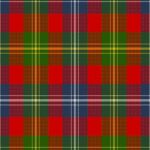
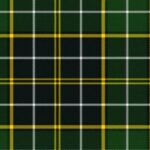
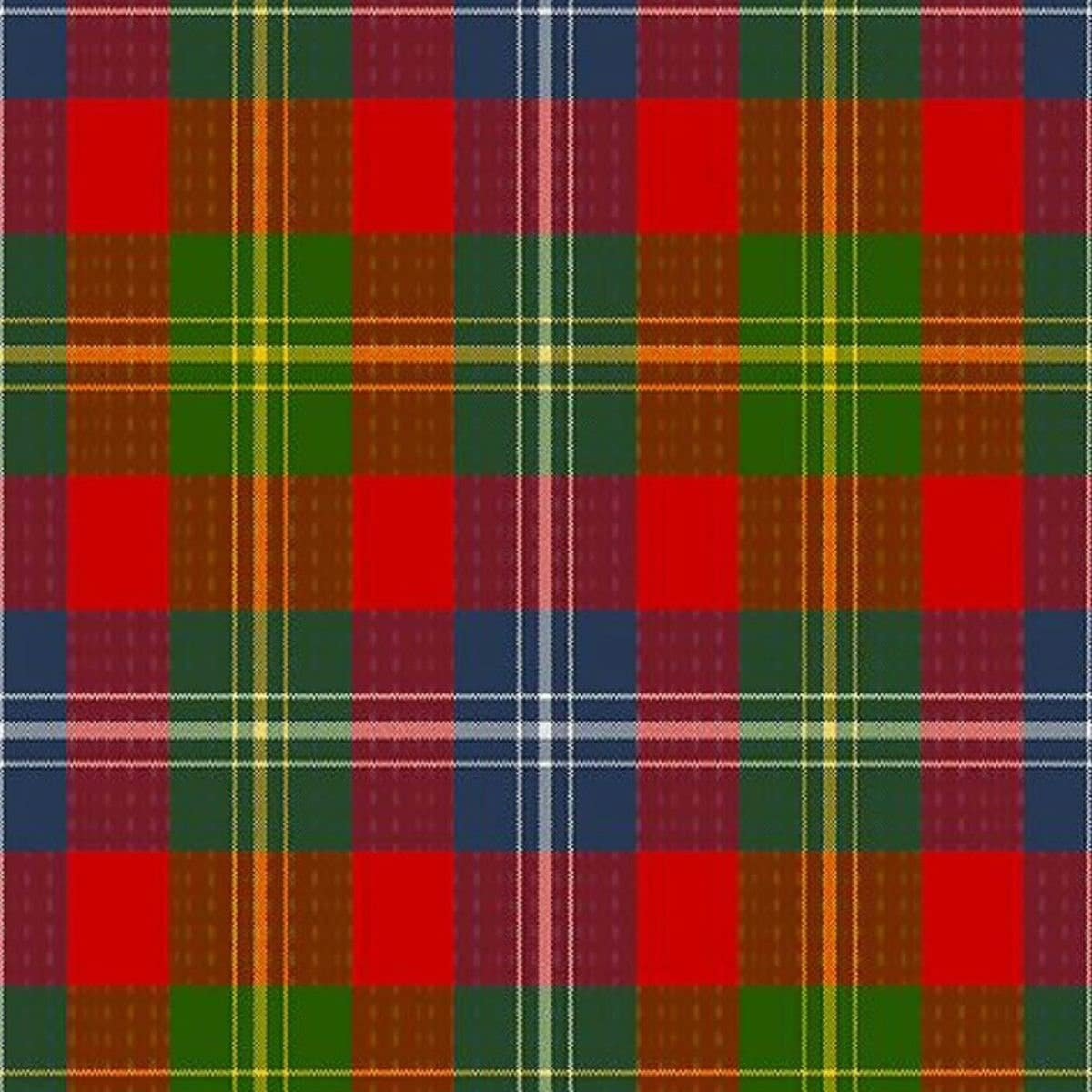
The Scottish Register of Tartans treats Forrester and Foster as one family and registers them together under hyphenated names: Forrester / Foster, dated 1990, and Forrester/Foster Hunting, dated 1985. Unusually, these are two genuinely distinct setts rather than one sett in two colourways: the clan pattern is built on blue and red with green, yellow and white, while the hunting pattern is black, yellow, green and white with no blue-and-red ground at all. The stripe sequences differ as well as the palette.
There is no separate Foster family tartan and no separate Forster family tartan. The Forster and Foster entries in the register are personal tartans from 2020. The clan society accepts Corstorphine, Forrester, Forrister, Forester, Forrest, Forest, Foster and Forister as one family, and the English Forresters of Etherstone and Forsters of Bamburgh share the bugle-horned arms — probable kinship, not proven descent. Some secondary sources date the two setts to 1987 and 1997 instead; we give the register’s dates and note the conflict. No designer is named in any source we could reach.
A note on honesty: Forrester Modern, Ancient, Weathered and Muted are colourways of the 1990 sett, not separate tartans — the only two distinct Forrester setts are the clan and the hunting. Neither predates the commercial era by any margin: both are designs of the 1980s, so no Forrester tartan can honestly be called medieval. A claim that the Lord Lyon granted official clan recognition in 1985 circulates on clan society pages and we could not corroborate it anywhere. The crest and motto belong to the chief personally, not to everyone of the name.
Clan facts
| Chief | Sources conflict. The 16th Lord Forrester of Corstorphine is Sir John Duncan Grimston, 7th Earl of Verulam, named as chief by some sources; others hold the clan armigerous with no chief recognised by the Lord Lyon |
|---|---|
| Motto | Blaw, Hunter, Blaw Thy Horn — Scots, referring to the family’s hereditary office of forest keeper |
| Plant badge | Not recorded |
| Lands | Corstorphine, Midlothian (castle demolished); Torwood, Stirlingshire; the barony of Garden; Strathendry Castle, Fife |