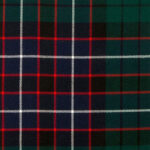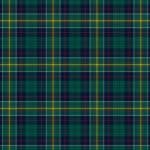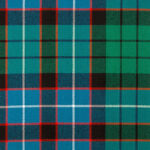
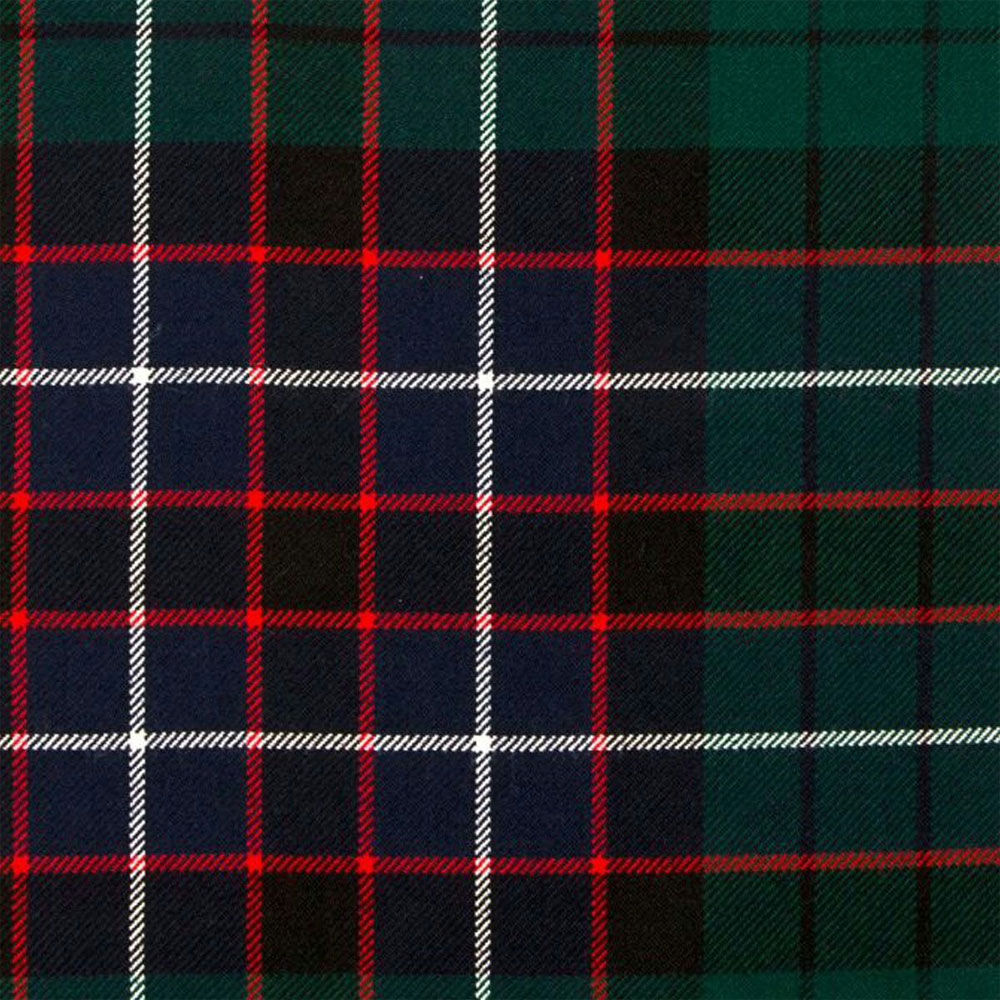
 Hunter Modern
Clan Hunter
The Hunters take an occupational name of Norman derivation, and tradition has them coming north with David I to lands called Hunter’s Toune. The earliest secure record is the Ragman Rolls of 1296, where Aylmer le Hunter of the county of Ayr submitted to Edward I. The family’s seat is Hunterston in North Ayrshire, where the keep was built by John Huntar, fourth Laird, in the late twelfth or early thirteenth century; it is a category A listed building and was restored by Robert Lorimer in 1926. Public access has been restricted since 1994 because of the neighbouring power stations, though clan members visit by arrangement.
The charter usually cited for the clan is genuine and can be dated closely. Robert II granted to William Hunter, tenth Laird of Hunterston, the lands of Arnell with pertinents for a penny of silver yearly at Pentecost, dated at Stirling on the second day of May in the fourth year of his reign — that is 2 May 1374, since Robert II acceded in February 1371. The original is said to remain at Hunterston. It is worth being precise about what it granted: Ardneil, or Arnell, the neighbouring farm, and not Hunterston, which the family already held. John Hunter, fourteenth Laird, was killed at Flodden in 1513 alongside James IV. The family has held Hunterston for something over eight hundred years, which the clan describes as an unbroken line, and is candid that this was achieved by diverting the inheritance through the female line when necessary; there have been five female chiefs.
The Hunter tartan
A search for Hunter returns seventeen entries, several of which have nothing to do with the family: Austrian Bowhunters Hunting, Bowhunter, The Bounty Hunter, and Upper Hunter, which is a district tartan for the Hunter Valley in New South Wales, along with four personal tartans. The genuine Hunter family setts are fewer than the count suggests.
The clan tartan worn today is Hunter of Hunterston, and it is a modern design with a documented history. It was commissioned by the clan from Captain T. Stuart Davidson, founder of the Scottish Tartans Society, in 1983, completed by 1985, and recorded with the Lord Lyon as LCB 81 on 11 November 1991. Two older entries, Hunter and Hunter (Wilsons’), are both credited in the register to Wilsons of Bannockburn; the clan’s own tartan history identifies these as Wilsons trade setts of 1790 and 1819 and is notably dismissive of them, observing that they had no historical association with Hunters, and we cannot say which register number corresponds to which year. Before 1983 many Hunters wore the shared sett registered as Russell or Mitchell or Hunter or Galbraith. Hunter of Peebleshire and Hunter of Bute are further distinct setts for which the register gives no designer and no date, and Hunter (USA) is a modern design by Peter MacDonald.
A note on honesty: no Hunter sett predates the commercial era. The oldest are Wilsons of Bannockburn trade patterns of the late eighteenth and early nineteenth centuries, which the clan itself does not regard as its own, and the tartan actually worn as the clan tartan dates from 1983 to 1985. One entry is called Hunter (1775), but the register gives it no designer and no date and we could not verify that 1775 refers to anything, so it should not be treated as a date. “Hunter Modern”, “Hunter Ancient” and “Hunter Weathered” are dye colourways of one threadcount, not separate tartans. And a point that catches people out constantly: “Hunting” setts, such as Hunting Stewart and the hunting variants of other clans, are green-ground day-wear patterns and have nothing whatever to do with the surname Hunter.
Clan facts
| Chief | Madam Pauline Natalie Hunter of Hunterston, Chief of the Name and Arms of Hunter and 30th Laird of Hunterston, who succeeded her father Neil Hunter in 1994 |
|---|---|
| Motto | Cursum perficio — “I will complete the course”, as the clan itself translates it. Some references print Currum perficio, which is an error |
| Plant badge | Sea pink, or thrift — Armeria maritima |
| Lands | Hunterston, North Ayrshire, held by the family for over eight hundred years, with Ardneil added in 1374. No Gaelic patronymic is recorded; the name is occupational and Anglo-Norman |