 MacTavish Modern
Clan MacTavish
Clann Tàmhais — the children of Thomas — held Dunardry in Knapdale, Argyll, where what remains of the castle lies beneath the Crinan Canal. The first feudal charter for Dunardry that we can date is 10 December 1533, from the Earl of Argyll, and that overlordship is the root of a long misunderstanding: in 1793 chief Lachlan MacTavish registered arms in which Campbell elements took the dominant quarters, and MacTavish was thereafter widely described as a sept of Clan Campbell. The arms were corrected in the 2000s under Lord Lyon Robin Blair, who moved the MacTavish buck’s head into the first and third quarters. Clan tradition that Dunardry was held from about 893 has no documentary basis and we do not repeat it as fact.
Dunardry was advertised for public auction on 5 November 1785 and the family lost the land, though the chiefship did not pass with it; one account has the estate bought by Simon McTavish of Montreal in 1799, and the sources do not agree on the sequence. The chiefship was restored on 23 July 1997, when Lord Lyon Malcolm Innes of Edingight confirmed Edward Stewart Dugald MacTavish as 26th chief, with the matriculation sealed on 13 December that year. The present chief is Steven Edward Dugald MacTavish of Dunardry, 27th chief, who succeeded his father in June 2005. A separate claim advanced in 1991 for a Garthbeg line was rejected for want of any deed of resignation or nomination.
The MacTavish tartan
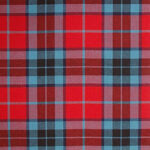
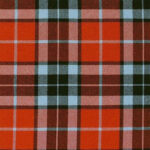
The main MacTavish sett carries a startling number of separate register reference numbers — well over a dozen — for what is one design recorded in different colourways and at different scales. It is the clearest illustration we know of why Modern, Ancient and Weathered entries should not be counted as separate tartans. Its earliest documented date is 1906, in Johnston’s publication. A second, larger sett shares the Thomson and Thompson names and was also recorded in 1906, coming into general use for the Thomsons around 1950.
The two best-known MacTavish patterns are modern commissions. MacTavish Hunting, which is also the Thomson Hunting sett, was designed in 1958 for Lord Thomson of Fleet from a mid-nineteenth-century sample in the Moy Hall collection and approved by the Lord Lyon that year. MacTavish Dress runs the identical band structure in different colours — the same sett, a second colourway — and was adopted as the official dress tartan by the 26th chief in 1998. Separately, MacTavish of Dunardry Dress is a recreation by the present chief, worked up from a letter of Sheriff Dugald MacTavish at Kilchrist dated 18 February 1845 which specified “as much white as there was yellow in the MacLachlans tartan”.
A note on honesty: no MacTavish sett is documented before 1906, so a claim that this tartan was worn in the fourteenth century is not supportable. Hunting and Dress are one sett in two colourways, not two tartans. Nothing in the MacTavish record comes from Wilsons of Bannockburn or from the Vestiarium Scoticum of 1842. The Jacobite white rose is widely given as the plant badge; we could not corroborate it in any independent source, so we record it as not recorded rather than pass it on.
Clan facts
| Chief | Steven Edward Dugald MacTavish of Dunardry, 27th Chief of Clan MacTavish (succeeded June 2005). Gaelic patronymic MacTàmhais; the clan form is Clann Tàmhais |
|---|---|
| Motto | Non Oblitus — “not forgotten”. Single-sourced; distinct from the Campbell Ne Obliviscaris |
| Plant badge | Not recorded. The Jacobite rose is widely quoted but we found no independent source for it |
| Lands | Dunardry, Knapdale, Argyll |