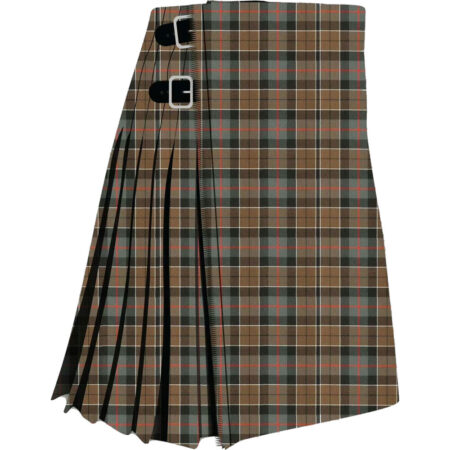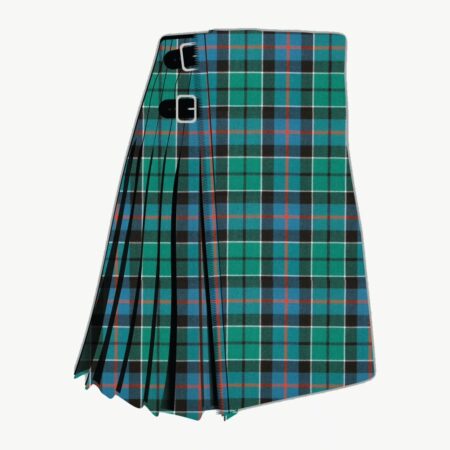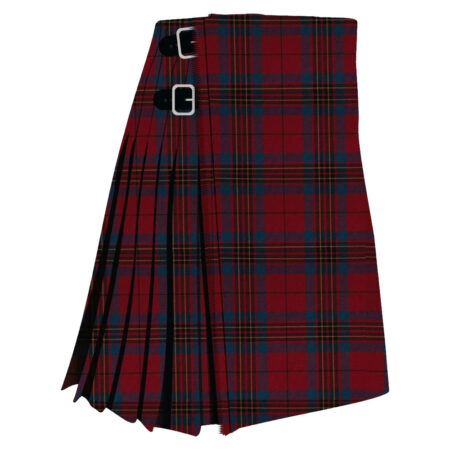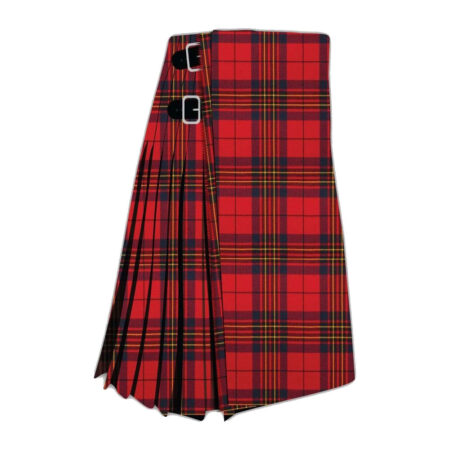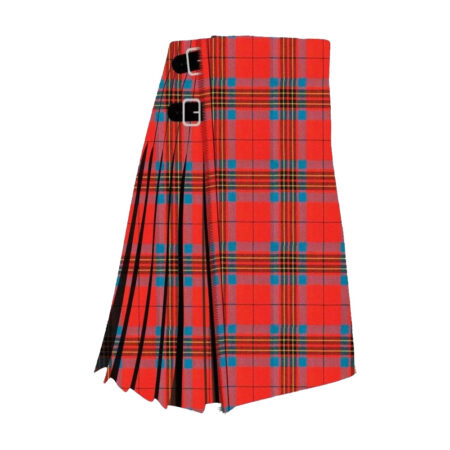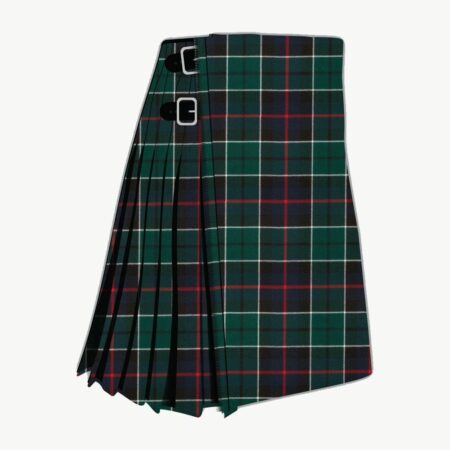
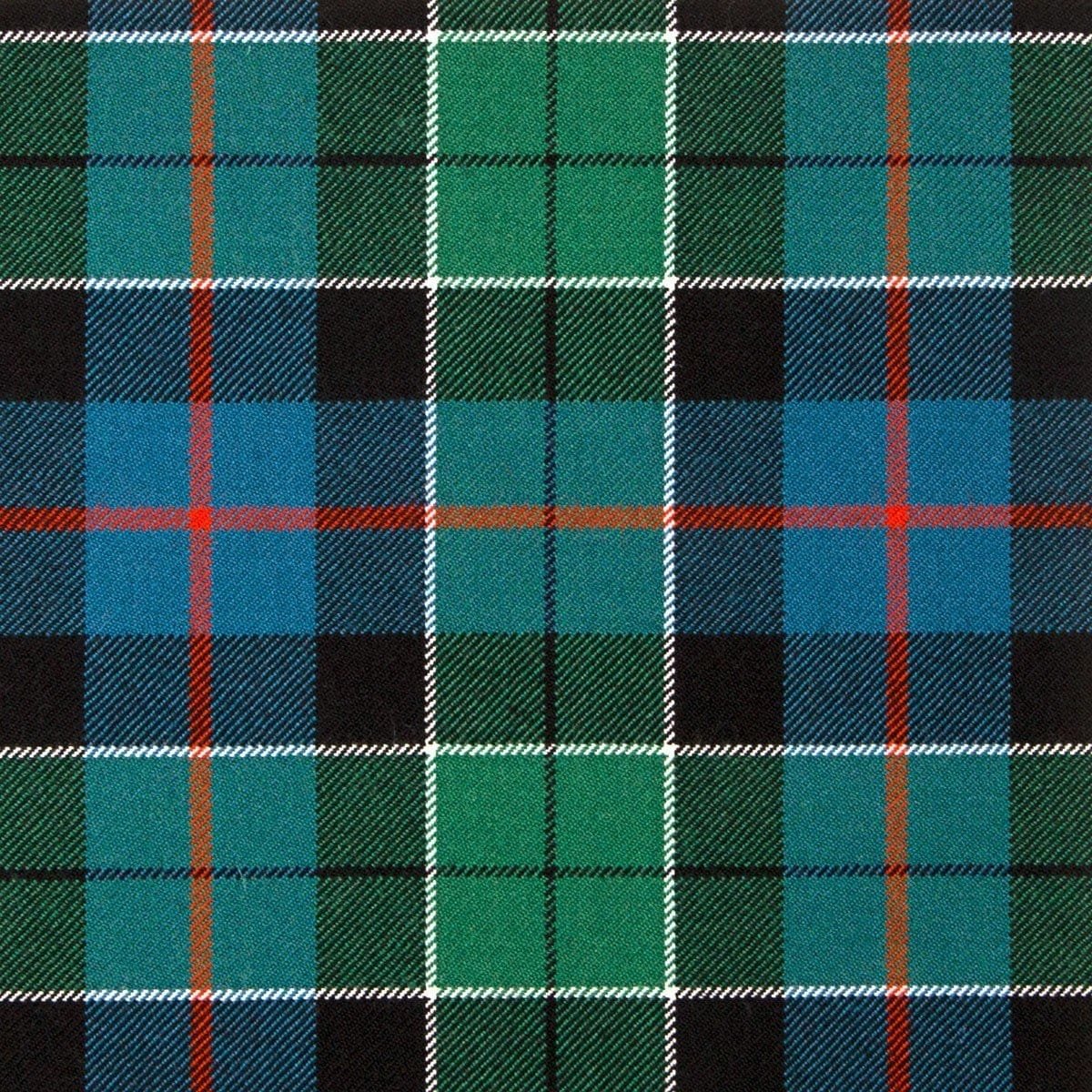
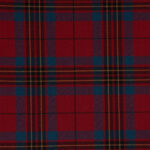
 Leslie Hunting Ancient
Clan Leslie
Leslie is a territorial name rather than a Gaelic patronymic, and no Gaelic form of it is recorded. It comes from the lands of Lesslyn, now Leslie, in the Garioch district of Aberdeenshire. The traditional founder is Bartolf, said to have reached Scotland about 1067 in the train of Edgar the Ætheling and his sister Margaret, to have been made first governor of Edinburgh Castle, and to have married Beatrix, sister of Malcolm III. The Hungarian descent that goes with this story rests on a claim made by a sixteenth-century descendant and repeated by nineteenth-century writers; there is no contemporary record of Bartolf, and the “Grip Fast” tale, in which he tells the queen to hold tight while carrying her across a river and so gives the family its motto and the buckles on its arms, is folklore of the same kind. The first Leslie who can be firmly dated is Bartolf’s reputed great-grandson Sir Norman de Leslie, who acquired the lands of Fythkill in Fife around 1282. Two branches carried the name forward, the Rothes line and the Balquhain line, and Leslies scattered across Europe into Russian, Swedish, French and Austrian service.
Sir Andrew de Leslie is among the named subscribers of the Declaration of Arbroath, dated 6 April 1320. At Harlaw on 24 July 1411 the laird of Balquhain was killed along with six of his sons. The earldom of Rothes was created in 1458 for George Leslie, and from then the earls were reckoned chiefs of the name; the 2nd Earl and his son were both killed at Flodden in 1513. On 29 May 1546 Norman Leslie, Master of Rothes, led the party that forced St Andrews Castle at daybreak and murdered Cardinal David Beaton, hanging his body from a window. The seventeenth century produced the two best-known Leslies, and they were soldiers rather than lairds. Alexander Leslie rose to field marshal in Swedish service by 1636, came home to command the Covenanter army as Lord General from 1638, broke the Royalists at Newburn in 1640, was made Earl of Leven in 1641 and commanded the allied army at Marston Moor in 1644. His kinsman David Leslie destroyed Montrose at Philiphaugh in 1645, then lost to Cromwell at Dunbar on 3 September 1650 and at Worcester on 3 September 1651, after which he spent the Interregnum in the Tower of London and was made Lord Newark at the Restoration. The 7th Earl was created Duke of Rothes in 1680, but the dukedom died with him in 1681 for want of a son.
The Leslie tartan
The Scottish Register of Tartans holds three Leslie records in its Clan/Family category: Leslie (J Cant), Leslie Hunting, and Leslie Red (VS). The rest of what a search for the name turns up is modern and unconnected — personal tartans registered between 2014 and 2021 and a corporate tartan for an engineering firm recorded in 2020. There is no plain “Leslie” clan record and no Wilsons of Bannockburn attribution under the name at all.
The red Leslie is the sett almost everyone means by Leslie tartan, and it is the only one of the three for which the Register names a designer. That entry reads: the Sobieski Stewarts.
A note on honesty: the Register is telling you, in its own designer field, that the Leslie tartan was invented. The Sobieski Stewarts were two brothers who styled themselves John Sobieski Stuart and Charles Edward Stuart, falsely claimed descent from Prince Charles Edward, and in 1842 published the Vestiarium Scoticum, a book of seventy-five tartan plates presented as copies from a fifteenth-century manuscript. The manuscript was never produced; chemical testing in 1895 by Stevenson Macadam showed that the supposed 1721 copy had been treated to make the writing look old. Neither the brothers nor the book are what they claimed to be, and the Leslie sett has no traceable existence before the 1840s. The Leslies were in any case a Lowland landed family of the Garioch and Fife, not a Highland kindred, so the idea of an inherited Leslie clan tartan is a Victorian one from start to finish. Leslie Ancient, Modern, Muted and Weathered are the same threadcount woven in different dye ranges, not four tartans.
Clan facts
| Chief | The Hon. Alexander Leslie, Chief of Clan Leslie. The chiefship is not held by his elder brother James, 22nd Earl of Rothes; their father the 21st Earl asked Alexander to take it, and he did so with his brother’s agreement and that of the Standing Council of Scottish Chiefs |
|---|---|
| Motto | Grip Fast — English, not Latin or Gaelic, and attached to a founding legend that cannot be documented |
| Plant badge | Rue |
| Lands | Leslie, formerly Lesslyn, in the Garioch, Aberdeenshire, with Balquhain; and in Fife, where Sir Norman de Leslie took Fythkill about 1282 and Leslie House near Glenrothes was the seat of the Earls of Rothes for over 250 years |
References
Versions of the Leslie tartan
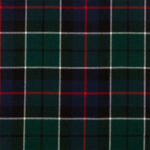
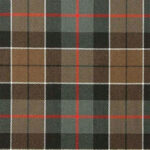
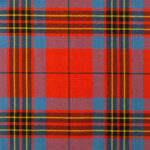
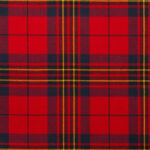
Leslie kilts & outfits
Every piece below is made to measure by Kilt 4 Less in the Leslie tartan. Choose a product, then pick your size and options.
Leslie Green Weathered Tartan Kilt
Original price was: £210.00.£122.00Current price is: £122.00.View kiltLeslie Green Ancient Tartan Kilt
Original price was: £210.00.£122.00Current price is: £122.00.View kiltLeslie Red Modern Tartan Kilt
Original price was: £241.80.£159.00Current price is: £159.00.View kiltLeslie Red Ancient Tartan Kilt
Original price was: £241.80.£159.00Current price is: £159.00.View kiltLeslie Green Modern Tartan Kilt
Original price was: £241.80.£89.00Current price is: £89.00.View kiltMen’s 8 Yard Prince Charlie Kilt Outfit
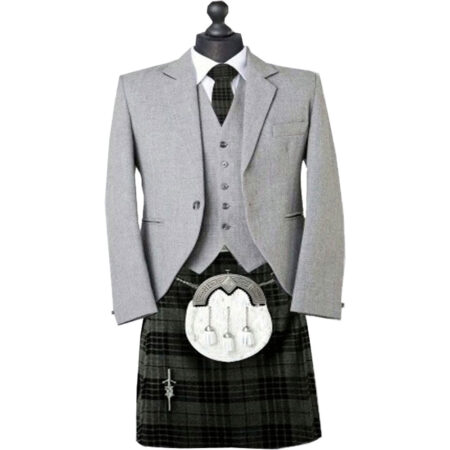
Original price was: £499.00.£315.00Current price is: £315.00.ConfigureMcCalls Highland Kilt Outfit With Argyll Jacket
Original price was: £510.00.£325.00Current price is: £325.00.ConfigureScottish Wedding Men Kilt Outfit
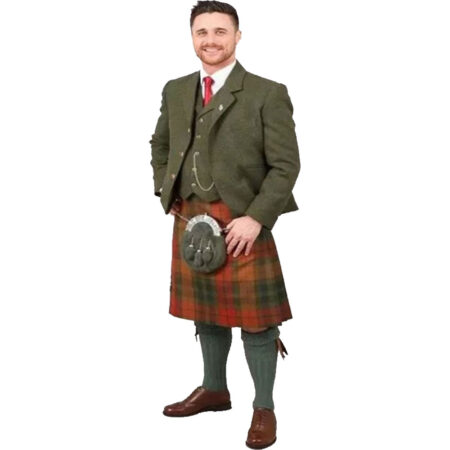
Original price was: £700.00.£304.00Current price is: £304.00.ConfigureForest Green Tweed Jacket Kilt Outfit
Original price was: £489.00.£249.99Current price is: £249.99.Configure