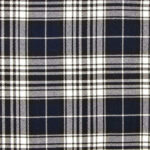
 Napier Modern
Clan Napier
The first certain reference is a charter of Malcolm, Earl of Lennox, granted some time before 1290, giving lands at Kilmahew in Dunbartonshire to John de Naper. That form of the name — de Naper — points to an occupational or territorial origin, and it sits awkwardly with the family’s favourite story, which rests on a 1625 affidavit and has a king telling a warrior named Donald Lennox that “ye have all done well, but there is one amongst you who hath na peer”. It is a good tale and it is legend. The frequent description of Napier as a sept of the MacFarlanes is a conventional association rather than a documented descent.
Alexander Napier, an Edinburgh merchant, obtained a charter for the lands of Merchiston in 1436 and became Provost of Edinburgh; his successor Sir Alexander was Comptroller of the Royal Household in 1440 and Vice Admiral of Scotland in 1461. The family’s most famous member is John Napier of Merchiston (1550–1617), who discovered logarithms, published the Mirifici Logarithmorum Canonis Descriptio in 1614 with the Constructio following posthumously in 1619, invented the calculating rods known as Napier’s bones, and did much to popularise the decimal point; sources disagree on which numbered laird of Merchiston he was, so we leave the ordinal out. His son Sir Archibald was created Lord Napier in the Peerage of Scotland in 1627, a date some sources give as 1625, and the Barony of Ettrick was created on 16 July 1872 for Francis, 10th Lord Napier, which is where the compound style comes from. The chiefship has never been dormant.
The Napier tartan
There is one Napier sett, and its provenance is better than most. Its earliest known date is 1816, and an older reference for it sits in the Highland Society of London collection — a body of cloth assembled around 1815–16 from samples certified by chiefs themselves. That makes Napier one of the patterns with a documented early-nineteenth-century pedigree rather than a later invention. It is neither a Wilsons of Bannockburn pattern book number nor a Vestiarium Scoticum design, and for a clan tartan that is worth saying plainly.
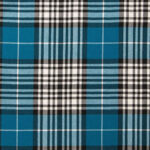
Two things sold under the name are not separate tartans. Napier Rose has the identical band structure to the clan sett, with the dark blue replaced by light rust and the white by a light neutral — a colourway, with no designer or date recorded. A smaller-count Napier record is the same design woven at reduced scale. And the Edinburgh Napier University tartan is a corporate tartan belonging to the university; it is not a Napier family sett and should not be listed as one.
A note on honesty: Napier Modern, Ancient and Weathered, and Napier Rose, are colourways of one sett. An 1816 date is early by tartan standards but it is still the commercial era, not the middle ages — no Napier sett predates it, and the family’s pre-1290 charter has nothing to do with cloth.
Clan facts
| Chief | Francis David Charles Napier, 15th Lord Napier and 6th Lord Ettrick (born 1962, succeeded 2012) |
|---|---|
| Motto | Sans Tache — “without stain” |
| Plant badge | Heather |
| Lands | Merchiston, Edinburgh, from the 1436 charter; earlier Kilmahew, Dunbartonshire. No current clan seat recorded |